The best matching games for classrooms turn practice into active learning. These picks cover memory, vocabulary, sight words, sorting, early reading, and themed play for preschool through early elementary students.
Use this roundup to find classroom-friendly games that match your learners’ ages, instructional goals, group size, and preferred level of challenge.
Best 10 Matching Games for Classrooms Picks for 2026
Farmyard Memory Builder

- 27 farm-themed matching pairs for early learners
- Large rounded cards with parent directions
- Supports 1–4 players and adjustable difficulty
Best For: Preschool and kindergarten vocabulary and memory practice
Hands-On Language Sorter
EAMAY Building Language Matching Set

- 36 everyday-object pieces and 6 sorting mats
- Two levels with and without picture clues
- Builds language, categorization, and fine motor skills
Best For: Early language and special education sorting activities
Dinosaur Vocabulary Challenge
Teacher Created Resources Dino Match

- 39 dinosaur pairs with labeled illustrations
- Includes directions and extra activity ideas
- Thick, coated cards for repeated play
Best For: Small-group dinosaur vocabulary and memory practice
Everyday Connections
CreateFun Go Together Flash Cards

- 50 cards forming 25 related-picture pairs
- Supports language, sequencing, and conversation
- Water-resistant, smudge-proof card coating
Best For: Language-rich matching, ESL, and speech activities
Reading Skills Pick

- Practices 20 frequently used first-grade sight words
- Can also serve as flash cards
- Compact, thick-cardboard set for small groups
Best For: Classroom literacy centers and early reading practice
Bright Group Play
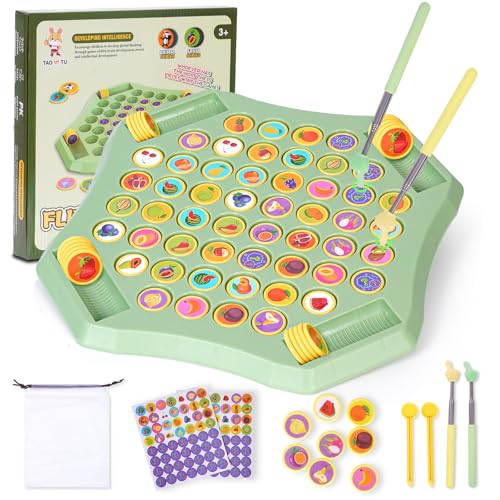
- Uses colorful fruit pictures for pair matching
- Builds recognition, memory, focus, and fine motor skills
- Suitable for kindergarten activities and classroom play
Best For: Colorful, simple memory practice and turn-taking
Animal-Themed Variety
72-Piece Animal Matching Cards

- Includes 36 pairs of real animal cards
- Double-sided design supports matching and drawing
- Thickened cards with rounded edges for young learners
Best For: Preschool animal-themed centers and flexible memory practice
Bluey Classroom Favorite

- 72 character picture tiles
- 15-minute rounds with simple rules
- Supports memory and pattern recognition
Best For: Preschool classrooms, indoor recess, and Bluey fans
Dinosaur Learning Pick

- 24 durable wooden matching cards
- Smooth, polished edges for little hands
- Supports recall and visual recognition
Best For: Preschool centers and small-group play
Everyday Vocabulary Builder
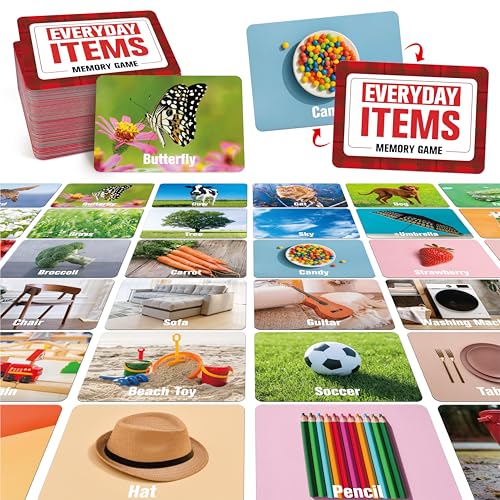
- 80 cards with 40 object pairs
- Builds memory and everyday vocabulary
- Smooth, rounded cards for handling
Best For: Preschool language activities and learning centers
Farmyard Memory Builder – School Zone Farm Card Game
For younger learners, this farm-themed deck is a straightforward choice among matching games for classrooms. It includes 27 matching pairs featuring farm animals and objects, allowing teachers to adjust the challenge by using some or all of the cards.
Best For: Preschool and kindergarten learners practicing visual memory, concentration, counting, and farm vocabulary.
Pros:
- Includes 54 game cards plus 2 parent cards with directions and activity tips.
- Large, rounded cards are designed to be easy to sort and handle.
- Supports one to four players and can be used for classroom rewards or independent activities.
- Portable carrying case simplifies storage and travel.
Cons:
- The farm theme may be less useful for classrooms seeking broader vocabulary practice.
- Designed for ages 3 and up, so it may be too basic for older students.
Choose this set when you want an approachable memory game with flexible difficulty and an early-learning focus. Its compact format also works well for small groups, take-home practice, or keeping children occupied while classmates finish their work.
Hands-On Language Sorter – EAMAY Building Language Matching Set
This manipulative-based set offers a more structured option for matching games for classrooms, especially when students benefit from picture cues and hands-on sorting. It combines 36 everyday-object pieces with six activity mats and two levels of play.
Best For: Toddlers, preschoolers, visual learners, and special education or language-building activities.
Pros:
- Includes 36 manipulatives and six large activity mats.
- Beginner play matches objects to corresponding photos.
- Advanced play removes picture clues and focuses on category matching.
- Supports language, classification, cognition, problem-solving, and fine motor practice.
Cons:
- Paper-based mats and pieces may require careful classroom handling.
- The set is aimed primarily at early learners rather than conventional pair-matching play.
- With 36 loose pieces, storage and sorting may take more classroom organization.
This is a strong fit when the instructional goal goes beyond finding identical pairs. The graduated play options let teachers start with visual matching and move toward categorization and language work as students gain confidence.
Dinosaur Vocabulary Challenge – Teacher Created Resources Dino Match
For science-themed matching games for classrooms, the Dino Match Game pairs visual memory practice with dinosaur names and prehistoric vocabulary. Its 39 pairs, labeled illustrations, and group-friendly format make it suitable for guided small-group play.
Best For: Preschool and elementary students learning dinosaur vocabulary, recall, and visual recognition.
Pros:
- Provides 78 cards, or 39 dinosaur matching pairs.
- Colorful illustrations and easy-to-read labels reinforce vocabulary.
- Supports two to four players and includes additional activity suggestions.
- Thick, coated cardstock is designed to withstand repeated use.
Cons:
- The dinosaur theme limits its relevance for non-science lessons.
- Its 39-pair deck may require more table space and sorting time than smaller sets.
Pick this game when you want a classic matching activity with a clear science connection. It can add variety to dinosaur units while giving students practice with memory, visual discrimination, reading, and speaking the featured names.
Everyday Connections – CreateFun Go Together Flash Cards
These picture cards broaden the idea of matching games for classrooms by pairing related everyday objects and concepts rather than relying only on identical images. The set is designed for conversation, language development, sequencing, and reasoning across a wide range of learners.
Best For: Preschool, ESL, speech therapy, autism learning, special education, and language-focused classroom activities.
Pros:
- Includes 50 cards forming 25 real-picture matching pairs.
- Can support communication, verbal concepts, sequencing, listening, and reasoning.
- Suitable for teachers, SLPs, ESL instruction, homeschool, daycare, and ABA activities.
- Cards have a smudge-proof and water-resistant coating.
Cons:
- It focuses on related-picture connections, so it may not provide a traditional memory-game experience.
- The cards are paper-based and may still need organized storage in busy classrooms.
- The broad age range may require teacher-led adaptation for different groups.
This is the most flexible option for classrooms where matching is a starting point for communication. Teachers can use the cards for simple pair finding or expand play into discussion, sequencing, vocabulary, and verbal reasoning practice.
Reading Skills Pick – First Grade Sight Word Memory
For classrooms seeking matching games for classrooms with a literacy focus, this sight word memory game combines classic pair matching with early reading practice. The First Grade set includes 20 frequently used sight words and can also be used as flash cards.
Best For: Kindergarten through second-grade reading centers, homeschool lessons, and small-group literacy practice.
Pros:
- Reinforces sight words while supporting reading, spelling, language, and concentration skills.
- Works with multiple players and can be scaled from five words to all 20.
- Thick cardboard cards are designed for repeated use and store in a compact box.
Cons:
- The First Grade set focuses on sight words rather than general picture matching.
- The product listing identifies one included card set, so larger classes may need multiple sets.
This is a practical choice when the goal is to turn sight-word repetition into an interactive classroom activity. Its compact format also makes it convenient for rotating literacy stations.
Bright Group Play – Fruit Memory Matching Game
This fruit-themed option brings visual variety to matching games for classrooms. Players flip two pieces at a time to find pairs, giving young learners practice with recognition, memory recall, focus, and turn-taking.
Best For: Kindergarten activities, playdates, family-style classroom games, and travel-friendly group entertainment.
Pros:
- Colorful fruit pictures make the matching task approachable for young children.
- Supports visual recognition, concentration, memory, fine motor skills, and social play.
- Designed for indoor use in classrooms, gatherings, and family game settings.
Cons:
- The listing specifies a two-player format, which may limit simultaneous participation.
- The product notes say stickers and accessories are provided and that the whole process requires DIY assembly.
Choose this set for a straightforward, colorful memory activity rather than a curriculum-specific game. Its simple turn-based format can fit short activity periods or supervised center time.
Animal-Themed Variety – 72-Piece Animal Matching Cards
For teachers wanting flexible matching games for classrooms, this animal card set provides 36 pairs featuring land, marine, and farm animals. Its double-sided cards support standard matching as well as creative activities using the blank reverse sides.
Best For: Preschool classrooms, animal-themed learning centers, and small-group cognitive-skill activities for children ages three and up.
Pros:
- Includes 72 cards, or 36 matching pairs, for a longer or more challenging game.
- Real animal imagery can encourage curiosity, focus, memory, and conversation.
- Blank backs allow children to draw and create additional games.
- Thickened cardboard, smooth rounded edges, and non-toxic plant ink are designed for young users.
Cons:
- The larger 36-pair set may be more challenging for younger preschoolers unless teachers use fewer pairs.
- The cards are made of paper, so classroom storage and handling still matter despite the thickened construction.
This set stands out for classrooms that want more pair options and built-in creative flexibility. Teachers can select a smaller group of pairs for beginners or use the full set for advanced memory practice.
Bluey Classroom Favorite – Bluey Matching Game
For classrooms seeking matching games for classrooms that are quick to teach and easy to replay, this Bluey-themed set offers a familiar, screen-free activity. Its 72 picture tiles support memory, focus, and pattern-recognition practice, with games lasting about 15 minutes.
Best For: Preschool classrooms, indoor recess, homeschool settings, and Bluey-themed learning activities.
Pros:
- Includes 72 picture tiles featuring Bluey characters.
- Simple rules and an approximately 15-minute play time.
- Supports cognitive skills, pattern recognition, and structured play.
- Can be played independently or with others.
Cons:
- The cartoon theme may be less appealing to children who are not Bluey fans.
- Cardboard tiles may require more care than wooden pieces.
This is a practical choice when you want a recognizable theme, short rounds, and flexible play for early learners or recess. The 3+ age recommendation makes it especially suitable for preschool-oriented classroom use.
Dinosaur Learning Pick – Wooden Dinosaur Memory Game
This wooden dinosaur set is a sturdy option for matching games for classrooms, especially when young children need tactile pieces for preschool practice. The 24 smooth-edged cards encourage concentration, recall, visual recognition, and turn-based play.
Best For: Preschool learning centers, small-group activities, and classroom or family play with children ages 3 and up.
Pros:
- Uses durable natural-wood tiles with polished, smooth edges.
- Dinosaur illustrations can make memory practice engaging.
- Supports concentration, matching, and memory skills.
- Offers single-player and two-player ways to play.
Cons:
- Includes 24 pieces, providing fewer pairs than larger card sets.
- The listed details identify two players, so it may be less suitable for whole-class play without multiple sets.
Choose this set when durability and easy-to-handle pieces matter more than a large collection of pairs. Its compact format works well for teacher-led small groups or a rotating classroom station.
Everyday Vocabulary Builder – Daily Items Matching Game
For teachers looking for matching games for classrooms that also introduce familiar vocabulary, this daily-items set provides 40 pairs across 80 cards. Children match objects such as books, pencils, apples, cars, and umbrellas while practicing memory, concentration, and verbal expression.
Best For: Preschool learning centers, language-building activities, classroom rewards, and interactive small-group play.
Pros:
- Includes 80 cards with 40 everyday-object pairs.
- Introduces common items while reinforcing matching and memory.
- Supports logical thinking, pattern recognition, and social interaction.
- Cards have smooth surfaces, rounded corners, and smooth edges.
Cons:
- The large number of cards may be more than needed for very young beginners.
- The supplied details list two players, so whole-class use may require rotating groups.
This set stands out when the activity needs to do more than test recall. Its everyday-object theme gives teachers natural opportunities to name, describe, and discuss what children see as they play.
How We Picked These Matching Games for Classrooms
We focused on games that offer a clear educational purpose alongside simple, repeatable play. The selection includes picture matching, memory pairs, everyday-object sorting, vocabulary practice, sight words, and themed options such as animals, dinosaurs, fruit, and Bluey. We also considered age range, card or piece count, classroom flexibility, and whether an activity can work for independent practice, partner play, centers, or indoor recess.
Because classroom needs vary, no single game is ideal for every group. Teachers should weigh the learning objective, student language level, attention span, and how easily pieces can be stored and replaced.
Quick Comparison
- Best for early concepts: Farm, fruit, animal, and everyday-object games support naming, categorizing, and visual recognition.
- Best for language development: Sets with real photographs, sorting mats, or object vocabulary can encourage conversation and expressive language.
- Best for literacy: Sight word matching adds reading practice for preschool, kindergarten, and early elementary learners.
- Best for themed engagement: Dinosaur and Bluey designs may help hesitant learners participate.
- Best for flexible group use: Larger sets provide more pairs and can accommodate multiple stations or differentiated play.
Key Buying Factors for Matching Games for Classrooms
Age and Developmental Level
Choose large, durable pieces with familiar images for younger children. Older students may benefit from words, sight words, less obvious matches, or more pairs that increase memory demands.
Learning Objective
Decide whether the priority is visual memory, vocabulary, phonics, reading fluency, categorization, or following directions. Picture-only games are usually more accessible, while word-based sets provide targeted literacy practice.
Set Size and Play Format
Count the pairs and consider how many students will use the game at once. A small set works well for one-on-one instruction or a quiet center; a larger set is better for groups, repeated practice, or dividing materials between tables.
Durability and Storage
Look for sturdy cards, easy-to-handle pieces, and a practical storage solution. Classroom materials are handled frequently, so compact sets with clearly matched pairs are easier to organize and distribute.
Accessibility and Differentiation
Realistic pictures, high visual contrast, and simple rules can support learners with varying language or developmental needs. Teachers can reduce the number of pairs for beginners, add spoken vocabulary prompts, or increase the challenge by requiring students to describe each match.
Who Should Buy Which Matching Games for Classrooms?
Preschool and kindergarten teachers should prioritize familiar pictures, oversized or easy-to-grip cards, and themes that encourage naming and turn-taking. Early elementary teachers may prefer sight word or vocabulary-focused games that reinforce current instruction. Special education and speech-language settings can benefit from sorting mats and real-object imagery that support categorization, receptive language, and communication practice. Teachers planning centers or indoor recess should look for durable, self-guided sets with enough pairs to keep several children engaged.
Whichever option you choose, introduce the matching rule clearly, model one round, and keep the initial number of pairs manageable. Then add pairs or learning prompts as students become more confident.