The best matching games for home use make screen-free play easy while helping children practice memory, focus, visual recognition, and turn-taking. This roundup covers simple preschool card games, themed tile sets, and more flexible family options.
Use the guide below to compare age ranges, card counts, educational themes, and replay value so you can choose a set that fits your child’s ability and your household’s style of play.
Best 10 Matching Games for Home Use Picks for 2026
Bluey Family Pick

- 72 Bluey picture tiles
- About 15 minutes per game
- Supports memory and pattern recognition
Best For: Bluey fans, preschoolers, and quick family play
Animal Learning Pick
Baby Animals Memory Matching Game

- 52 tiles make 26 pairs
- Cute baby-animal theme
- Built for ages 3 and up
Best For: Preschoolers learning memory and animal recognition
Versatile Card-Game Set

- Four decks in one pack
- Includes Memory Match and three other games
- Portable, individually boxed decks
Best For: Families seeking variety for home, travel, or classrooms
Food-Themed Pick
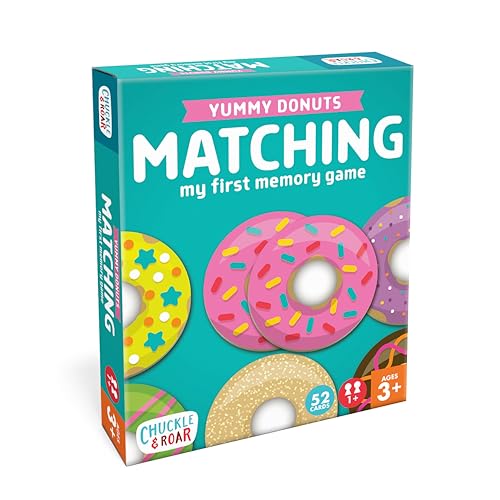
- 52 colorful donut tiles
- Solo or up to four players
- Compact for travel
Best For: Preschoolers who enjoy playful food themes
Artful Bilingual Pick
Famous Paintings Memory Matching Game

- 35 pairs featuring famous paintings
- English-and-Spanish artist and title text
- Compact cards for family, classroom, or travel play
Best For: Bilingual families and art-focused learning
Colorful Family Choice
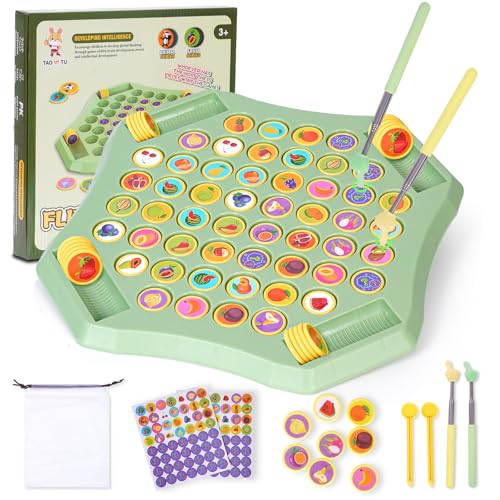
- 54 bright fruit-themed matching pieces
- Simple rules for young players
- Supports memory, focus, and fine motor practice
Best For: Young children and two-player family activities
Farm-Themed Learning Deck

- 27 farm-themed matching pairs
- Parent cards include rules and variations
- Portable format for 1–4 players
Best For: Preschool and kindergarten learning play
Everyday Learning Pick
Hebayy 72-Piece Daily Items Matching Game

- 36 everyday-object pairs on thickened tiles
- Blank backs allow custom games and drawings
- Rounded, wipe-clean cards for preschool play
Best For: Preschoolers learning through familiar objects
Family Variety Pick
Zubebe 4-Set Memory Matching Card Game

- Four themes: animals, fruits, dinosaurs, and food
- Quick flip-and-match rules with included instructions
- Useful for family nights, classrooms, or party favors
Best For: Multi-player play with rotating themes
Large-Card Learning Pick
80-Piece Daily Items Matching Game
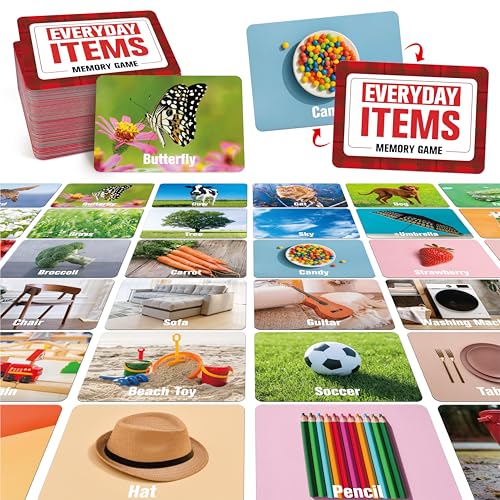
- 40 everyday-object pairs across 80 cards
- Larger cards support visibility and handling
- Encourages memory, concentration, and vocabulary
Best For: Preschool learning and guided activities
Bluey Family Pick – Bluey Matching Game
For families looking for matching games for home use, this Bluey-themed set combines familiar characters with a simple memory format. Its 72 picture tiles and roughly 15-minute playtime make it practical for preschool play, family game nights, or independent matching practice.
Best For: Bluey fans ages 3 and up, preschool learning, and short screen-free family activities.
Pros:
- Features Bluey, Bingo, Bandit, and Chilli picture tiles.
- Includes 72 tiles for classic matching play.
- Supports memory, focus, pattern recognition, and visual matching.
- Designed for solo or group play with an estimated 15-minute playing time.
Cons:
- The character theme may appeal less to children who are not Bluey fans.
- Cardboard tiles may require careful handling from younger children.
This is a straightforward choice when themed artwork and quick rounds matter. It offers a familiar classic game format with an emphasis on early cognitive skills and family participation.
Animal Learning Pick – Baby Animals Memory Matching Game
This baby-animal memory game is a practical option for matching games for home use, especially when you want an easy first game for preschoolers. The 52 thick cardboard tiles create 26 pairs for classic matching, with bright animal imagery that supports recognition and recall.
Best For: Children ages 3 and up, preschool learning, daycare, and simple solo or group play.
Pros:
- Uses cute baby-animal pictures to encourage matching and animal-name learning.
- Includes 52 thick cardboard tiles, or 26 matching pairs.
- Supports memory, visual recognition, focus, and concentration.
- Can be played independently or with friends and family.
Cons:
- The animal theme may be less engaging for children seeking licensed characters.
- The listed player capacity is up to four, so larger groups may need another activity.
With its approachable theme and uncomplicated rules, this set works well as an introductory memory game. It is particularly suited to repeated preschool play at home, school, or daycare.
Versatile Card-Game Set – Four Classic Kids Card Games
If you want more variety than a single matching game, this four-deck set expands matching games for home use into a broader family card-game collection. It includes Go Fish, Old Maid, Slap Jack, and Memory Match, with themed decks that are also compact for travel or classroom activities.
Best For: Families wanting multiple classic games, playdates, travel, and children learning basic memory and matching skills.
Pros:
- Includes four games in one pack: Go Fish, Old Maid, Slap Jack, and Memory Match.
- Uses ocean, profession, food, and animal themes for visual variety.
- Thick paper cards are sized for children and adults to handle.
- Individually boxed decks are convenient for storage and portability.
Cons:
- It is a card-game collection rather than a dedicated tile-based matching set.
- The supplied details list a manufacturer-recommended age of 6–7 years, which may be older than some marketing references.
This set makes sense for households that want one purchase to cover several familiar games. Its main advantage is flexibility: children can switch between matching, memory, and more interactive card formats.
Food-Themed Pick – Donuts Memory Matching Game
For a playful addition to matching games for home use, this donut-themed memory game gives preschoolers a colorful visual challenge. Its 52 cardboard tiles provide multiple matching pairs, while the compact box also makes it suitable for playdates and travel.
Best For: Children ages 3 and up who enjoy food-themed designs, solo play, or games with up to four players.
Pros:
- Includes 52 vibrant donut-themed tiles for extended matching sessions.
- Supports memory, concentration, visual recognition, and cognitive development.
- Offers solo play or group play for up to four players.
- Compact packaging makes it convenient for travel and on-the-go activities.
Cons:
- The food theme may not appeal to every child.
- Paper and cardboard components may need care during frequent handling.
This is a good fit when colorful novelty matters as much as the matching activity itself. It keeps the classic format simple while adding enough pairs for repeat play at home or away.
Artful Bilingual Pick – Famous Paintings Memory Matching Game
For matching games for home use that add an educational element, this Menique set pairs classic artwork with traditional concentration play. Its 35 illustrated pairs feature paintings associated with artists including Van Gogh, Da Vinci, and Monet, while bilingual card text adds English-and-Spanish learning.
Best For: Families, classrooms, and art-loving players seeking a screen-free memory game for children and adults.
Pros:
- Includes 70 cards forming 35 pairs of famous paintings.
- Artwork titles and artist names appear in English and Spanish.
- Laminated, rounded-corner cards are compact for home, classroom, or travel use.
- Supports memory, attention, visual recognition, and family interaction.
Cons:
- The art-focused theme may be less appealing to players who prefer conventional picture matching.
- The supplied notes describe cards but do not indicate a separate storage tray or game board.
With 2–10 player support and an estimated 30-minute playing time, this is a flexible choice for mixed-age game sessions. Its bilingual artwork presentation makes it especially useful when play and cultural learning are equally important.
Colorful Family Choice – Fruit Memory Matching Game
This fruit-themed set is a straightforward option for matching games for home use, using colorful fruit images and simple turn-based rules. Players flip two pieces, keep matching pairs, and practice visual recognition, concentration, memory recall, and fine motor skills.
Best For: Young children, family play, classroom activities, playdates, and screen-free travel entertainment.
Pros:
- Includes 54 fruit-themed pieces with bright picture designs.
- Simple flip-two-and-match gameplay is easy for children to learn.
- Supports memory, focus, visual recognition, and fine motor practice.
- Designed for indoor family, classroom, gathering, and travel use.
Cons:
- The listed format is for two players, limiting larger-group play.
- The notes say stickers and accessories are provided and that the whole process requires DIY assembly.
- No rulebook is listed in the supplied details.
This game offers an accessible introduction to matching play for children ages 3 to 9. Buyers should account for the required DIY process and the two-player format before choosing it for home use.
Farm-Themed Learning Deck – School Zone Memory Match Farm
For families comparing matching games for home use, School Zone Memory Match Farm combines familiar barnyard imagery with early-learning practice. The deck includes 27 matching pairs, and players can use some or all of the cards to adjust difficulty for one or more players.
Best For: Preschool and kindergarten children practicing concentration, visual memory, farm vocabulary, counting, and matching.
Pros:
- Includes 54 game cards plus two parent cards with directions and tips.
- Large rounded cards feature bright, colorful farm illustrations.
- Adjustable difficulty lets players use some or all of the 27 pairs.
- Portable boxed format supports home, classroom, and on-the-go play for 1–4 players.
Cons:
- The farm theme and early-learning focus are primarily geared toward young children.
- The supplied description identifies a card deck rather than a board-based game.
This is a practical pick when you want matching play to reinforce early vocabulary and visual-memory skills. The adjustable card count is useful for tailoring sessions to a child’s age, attention span, or experience level.
Everyday Learning Pick – Hebayy 72-Piece Daily Items Matching Game
For families seeking matching games for home use, the Hebayy set combines familiar objects with a classic memory-pair format. Its 72 thickened tiles offer 36 designs, while the blank reverse sides allow children to create additional games.
Best For: Preschoolers ages 4 to 6 who enjoy object-based learning and repeat play.
Pros:
- Includes 36 everyday-object pairs across 72 tiles.
- Double-sided cards support drawing and custom game ideas.
- Thick cardboard, rounded edges, and wipe-clean surfaces suit young players.
- Requires no batteries and supports memory, focus, and pattern recognition.
Cons:
- The 2-by-2-inch cards are relatively small for some children.
- The set is primarily designed for indoor, two-player use.
The familiar daily-items theme makes this a straightforward choice for introducing matching play while connecting cards to objects children see around the home.
Family Variety Pick – Zubebe 4-Set Memory Matching Card Game
The Zubebe four-set collection is a flexible option for matching games for home use, with separate animal, fruit, dinosaur, and food themes. The included instructions explain a simple flip-and-match format that families can learn quickly.
Best For: Families, classrooms, and party settings that want several themes to rotate between players.
Pros:
- Provides four themed sets for varied play.
- Bright, lightweight blue-core paper cards have a smooth, non-glare surface.
- Rules are simple enough to learn in less than five minutes.
- Supports memory, vocabulary, critical thinking, and hand-eye coordination.
Cons:
- The listing gives an inconsistent piece count, describing 39 pieces while also specifying four sets.
- Its recommended age details vary, so buyers should review the packaging guidance.
- The cards are smaller than many standard game cards.
With four subjects and multiplayer scoring, this set is especially useful when different children or groups want different visual themes during game time.
Large-Card Learning Pick – 80-Piece Daily Items Matching Game
For matching games for home use with larger cards, this 80-piece daily-items set presents 40 pairs featuring objects such as cars, umbrellas, pencils, apples, books, and lamps. The familiar imagery supports memory practice while introducing everyday vocabulary.
Best For: Preschool learning, language-building activities, and supervised play with children ages 3 and up.
Pros:
- Includes 40 pairs across 80 cards.
- Larger 2.9-by-4.1-inch cards are easy to view and handle.
- Everyday objects can support object recognition and vocabulary development.
- Smooth surfaces and rounded edges are designed for regular handling.
Cons:
- Only one daily-items theme is included.
- The larger format may require more table space.
- The supplied details list differing age descriptions, so check the product labeling.
This is a practical choice when visibility matters more than portability, particularly for parents, teachers, or therapists using matching play as part of a learning routine.
How We Picked the Best Matching Games for Home Use
We focused on practical features that matter during everyday family play: recommended age, number of cards or tiles, theme clarity, ease of setup, and flexibility for different skill levels. The selection includes compact card games, larger memory sets, classic multi-game packs, and educational designs covering animals, food, household objects, art, and early learning.
Because matching games are often shared by siblings or played repeatedly, we also considered whether a set can scale in difficulty. Games with fewer pairs may suit beginners, while larger sets offer a longer challenge for older children and adults.
Quick Comparison
| Best For | Look For | Notable Options |
|---|---|---|
| Toddlers and preschoolers | Large, clear pictures and simple rules | Bluey, Baby Animals, Farm |
| Family game night | Multiple game modes or broad age appeal | Four-in-one card games, Zubebe |
| Educational play | Vocabulary, counting, or recognition themes | School Zone, Daily Items |
| Older kids and adults | More pairs or a distinctive theme | Famous Paintings, Fruit |
| Longer challenges | Higher card or tile counts | 72-piece and 80-piece sets |
Key Buying Factors for Matching Games for Home Use
Age and Difficulty
Start with the recommended age, but also consider attention span and previous experience. Younger children typically do better with fewer pairs, bold images, and durable cards. Older players may prefer more pairs, smaller visual differences, or a theme that adds an extra layer of interest.
Card and Tile Count
A larger set creates a tougher memory challenge but can overwhelm beginners and take longer to reset. Smaller sets are easier for quick sessions, travel, or independent practice. Check whether the listed quantity refers to individual cards, tiles, or complete matching pairs.
Theme and Learning Value
Choose familiar pictures for first games, such as animals, fruit, or everyday objects. Vocabulary, counting, farm, and art themes can add learning opportunities without changing the basic rules. Bilingual or subject-based sets may be especially useful for guided play.
Storage and Durability
Look for cards or tiles that are easy to shuffle, turn, and store. A compact box or bundled decks can help prevent missing pieces. For younger children, thicker pieces and large, easy-to-grip formats are preferable.
Who Should Buy Which Matching Games for Home Use?
Choose the Bluey, Baby Animals, or Farm options for preschoolers who benefit from recognizable images and straightforward matching. Families wanting variety should consider the four-deck classic card-game pack or a multi-set option. For learning-focused play, Daily Items and School Zone designs support naming, recognition, and early academic skills.
Choose a larger 72- or 80-piece everyday-object game when you want a more demanding activity for older children or mixed-age play. The Famous Paintings set is a strong choice for art-minded families and adults, while Fruit offers a colorful theme with broader family appeal. If you are unsure, prioritize the simplest set that matches the youngest regular player; you can add more pairs as confidence grows.