The best marble runs for classrooms turn physics, engineering, and problem-solving into hands-on activities students can see and adjust. The right set can also support teamwork, fine-motor practice, and open-ended design.
We compared these 10 classroom-friendly options by age range, piece count, construction style, durability, storage, and learning potential so teachers can choose a set that fits their space and lesson goals.
Best 10 Marble Runs for Classrooms Picks for 2026
Best for Big-Build Engineering

- 215 pieces and 40 marbles
- Includes jump, split, funnel, and spinner elements
- Designed for ages 4 and up
Best For: Open-ended classroom engineering and building challenges
Best for Letter Practice
MarbleTracers Lowercase Letters

- 26 lowercase letter trays
- Includes stroke guides and baselines
- Designed for ages 3–5
Best For: Preschool handwriting and alphabet-learning centers
Best for Organized Classroom Play
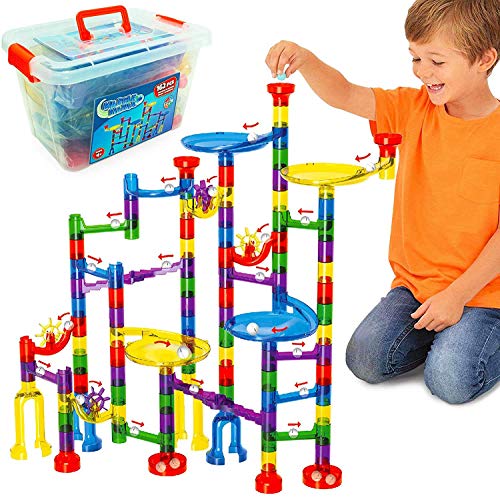
- 162 pieces with 72 marbles
- Includes four-build guidebook
- Comes with a storage tub
Best For: Guided construction centers with simple cleanup
Best for Interactive STEM Demonstrations

- 236 pieces with motorized elevator
- Includes 30 glow-in-the-dark marbles
- Supports continuous marble circulation
Best For: High-interest group demonstrations and collaborative builds
Best Magnetic Tile Pick
PicassoTiles 100-Piece Marble Run
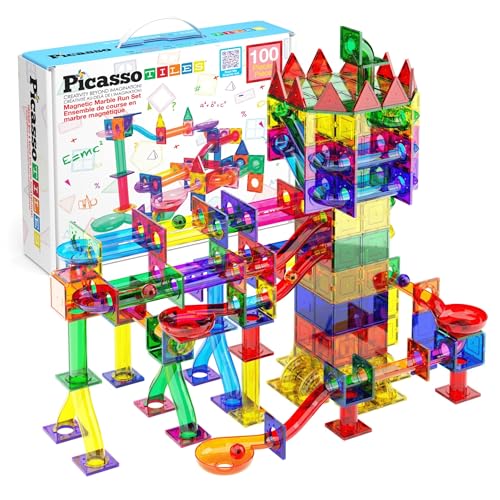
- 100 pieces with magnetic tiles, ramps, funnels, U-turns, and five steel marbles.
- Supports hands-on STEM, spatial reasoning, fine motor skills, and teamwork.
- Compatible sizing makes it easy to expand with other PicassoTiles sets.
Best For: Preschool and early elementary classroom building centers
Best Glow-In-The-Dark Set
National Geographic Glow Marble Run

- 80-piece construction kit with sturdy bases, action pieces, and smooth-run tracks.
- Includes 15 glow-in-the-dark glass marbles in six colors.
- Guide introduces motion, aerodynamics, and marble-run experiments.
Best For: Ages 8+ STEM lessons and physics demonstrations
Best Wooden Engineering Set

- 101-piece wooden marble run with spirals, ramps, see-saws, and direction controls.
- Includes 50 marbles and varied components for repeatable engineering challenges.
- Supports spatial thinking, problem-solving, counting, teamwork, and STEAM skills.
Best For: Cooperative early elementary engineering activities
Best STEM Pick
National Geographic Glow Marble Run

- 150 pieces support varied track designs
- Includes physics guide and experiments
- Glow glass marbles add visual appeal
Best For: Elementary classrooms and hands-on STEM activities
Best Versatile Classroom Set
MaxTronic 110-Piece Marble Run

- 50 pieces and 60 marbles support repeated play
- Works across ages 3 to 12
- Encourages problem solving and spatial thinking
Best For: Mixed-age classrooms and collaborative STEM centers
Best for Early Learners
National Geographic Junior Jumbo Marble Run

- Designed for ages 2 and up
- Uses jumbo pieces and child-safe balls
- Includes starter courses and activity cards
Best For: Toddler and preschool classroom centers
Best for Big-Build Engineering – Mega Marble Run
For classrooms seeking marble runs for classrooms that support open-ended construction, the MindWare Mega Marble Run offers 215 durable pieces and 40 marbles. Its assortment of chutes, spinners, funnels, splitters, and jump elements gives students room to experiment with paths, balance, and cause and effect.
Best For: Group engineering activities and creative building with children ages 4 and up.
Pros:
- Includes 215 pieces and 40 marbles for larger builds and races.
- Pieces stack and click together, then pull apart with ease.
- Features splitters, funnels, wheels, spinners, and a jump slide.
- Supports hand-eye coordination, spatial skills, and trial-and-error learning.
Cons:
- The large assortment may require substantial classroom storage space.
- At 6.5 pounds, it is less convenient to move frequently between centers.
This is a strong choice when the priority is maximum construction variety rather than a compact activity. Its many components can support repeated design challenges, though teachers should plan a storage and sorting system.
Best for Letter Practice – MarbleTracers Lowercase Letters
Unlike traditional marble runs for classrooms, MarbleTracers uses marble movement to guide lowercase letter formation. The 26 trays include starting dots, molded stroke tracks, and baselines, making this a focused hands-on option for preschool writing centers.
Best For: Preschool and kindergarten alphabet recognition, fine-motor practice, and early handwriting activities.
Pros:
- Includes 26 lowercase letter trays and 10 white marbles.
- Built-in guides support stroke order and letter formation.
- Combines tactile, visual, and movement-based learning.
- Compact dimensions make it suitable for a classroom activity center.
Cons:
- This is a letter-tracing system, not a conventional track-building marble run.
- Only 10 marbles are included for the 26 trays.
- The supplied notes do not list a warranty.
MarbleTracers is best treated as a literacy manipulative rather than a racing activity. It offers a clear, structured way to reinforce letter formation while adding fine-motor engagement to preschool classroom routines.
Best for Organized Classroom Play – Marble Mania
For teachers comparing marble runs for classrooms, Marble Mania combines construction play with convenient cleanup. The set includes 90 building pieces, 72 marbles, a guidebook with four example runs, and a storage tub for keeping the materials together.
Best For: Ages 4 and up, especially classrooms that need guided builds and straightforward storage.
Pros:
- Complete 162-piece set includes 90 construction pieces and 72 marbles.
- Translucent pieces let children watch marbles travel through the run.
- Includes a full-color guidebook with four example designs.
- Storage tub keeps the pieces together after activities.
Cons:
- It offers fewer building pieces than the 215-piece MindWare set.
- The included marbles are a mix of glass and plastic, requiring careful classroom supervision.
This set stands out for classrooms balancing creative construction with easy organization. The guidebook can help students get started, while the translucent tracks leave room for independent designs and visual problem-solving.
Best for Interactive STEM Demonstrations – JOYIN Glowing Elevator Run
The JOYIN Glowing Marble Run adds motion and visual excitement to marble runs for classrooms with a motorized elevator and glow-in-the-dark marbles. Its 236-piece set supports large builds, while the elevator creates a continuous lift-and-drop cycle for demonstrations and collaborative play.
Best For: Engaging group demonstrations and construction activities for children ages 3 and up.
Pros:
- Includes 176 track pieces and 60 marbles across plastic, glow-in-the-dark, and glass types.
- Motorized elevator repeatedly lifts marbles for an ongoing run.
- Glow-in-the-dark marbles add a distinctive low-light activity element.
- Large 236-piece set supports collaborative building.
Cons:
- The motorized elevator adds a powered component that may require teacher setup and supervision.
- Glow effects are most useful when classroom lighting can be reduced.
- The notes identify hand-eye coordination as the educational objective but provide limited detail about other learning goals.
This is the most spectacle-oriented option in the group. The elevator and glowing marbles can capture attention during a STEM demonstration, while the substantial piece count provides a foundation for collaborative construction.
Best Magnetic Tile Pick – PicassoTiles 100-Piece Marble Run
For classrooms seeking marble runs for classrooms that support open-ended STEM play, the PicassoTiles 100-piece set combines magnetic construction with gravity-powered maze building. Students can create slopes, funnels, and U-turns while practicing spatial reasoning and problem-solving.
Best For: Preschool and early elementary classroom centers, collaborative building, and expandable magnetic-tile play.
Pros:
- Includes 100 pieces with magnetic tiles, slopes, funnels, U-turns, and five steel marbles.
- Supports STEM exploration, hand-eye coordination, fine motor skills, and creative thinking.
- Standard PicassoTiles sizing allows expansion with other compatible sets.
- Made from BPA-free, non-toxic, lead-free materials and tested to stated safety standards.
Cons:
- Recommended for ages 3 and up, so it may be less suitable for older students seeking more advanced construction.
- Magnetic tile construction may require a stable building surface for taller layouts.
Choose this set when flexibility and shared building matter most. Its familiar magnetic-tile format makes it practical for classroom stations where students can repeatedly redesign and test their marble paths.
Best Glow-In-The-Dark Set – National Geographic Glow Marble Run
The National Geographic Glow-in-the-Dark Marble Run is a strong option for marble runs for classrooms serving older children. Its tight-fit track pieces, glow-in-the-dark glass marbles, and included physics guide make it suitable for structured construction challenges and motion experiments.
Best For: Elementary classrooms with students ages 8 and up, STEM lessons about motion, and engaging after-light or dim-room demonstrations.
Pros:
- Includes 80 pieces, five sturdy bases, 15 action pieces, 45 track pieces, and 15 glow-in-the-dark glass marbles.
- Tight-fitting pieces are designed to help completed tracks stay together during play.
- Learning guide covers physics of motion, aerodynamics, and construction experiments.
- Large storage bag and marble pouch simplify classroom cleanup.
Cons:
- Recommended for ages 8 and up, limiting its fit for younger classroom groups.
- Glass marbles require careful handling and appropriate classroom supervision.
This set stands out when the goal is to connect building with a defined STEM lesson. The glow feature adds visual interest, while the storage solution helps keep the many pieces organized between activities.
Best Wooden Engineering Set – Hape Quadrilla Super Spirals
For classrooms that prefer substantial construction challenges, the Hape Quadrilla Super Spirals offers a 101-piece wooden marble run with spiral twists, see-saws, ramps, and adjustable direction controls. It encourages students to plan, build, test, and revise larger marble-run designs.
Best For: Early elementary classrooms, cooperative engineering activities, and hands-on STEAM exploration for children ages 4 and up.
Pros:
- Includes 101 components, 50 marbles, spiral twists, distributor blocks, ramps, see-saws, and a xylophone rail.
- Knob-and-button distributor block lets builders change marble direction.
- Encourages spatial thinking, problem-solving, counting, teamwork, and STEAM development.
- Non-toxic, child-safe finishes are designed for durable play.
Cons:
- At 9.5 pounds, it is heavier than the other listed sets and may be less convenient to move between centers.
- The extensive component selection may require more setup and sorting time.
This is a compelling classroom choice when students benefit from a more involved engineering experience. Its adjustable and interactive elements provide many opportunities to compare designs and collaborate on increasingly complex tracks.
Best STEM Pick – National Geographic Glow Marble Run
For classrooms seeking marble runs for classrooms with strong building variety, this 150-piece National Geographic set combines sturdy construction with glow-in-the-dark glass marbles. Its learning guide also introduces motion, gravity, and marble-run experiments.
Best For: Elementary classrooms and older children seeking a hands-on STEM construction activity.
Pros:
- Includes 9 bases, 26 action pieces, 85 smooth-run tube pieces, and 30 glow-in-the-dark glass marbles.
- Tight-fit pieces are designed to keep completed tracks from falling apart during play.
- Learning guide includes physics concepts and construction experiments.
- Storage bag and marble pouch help keep classroom materials organized.
Cons:
- Recommended for ages 8 and up, so it is not intended for preschool classrooms.
- Glass marbles require appropriate classroom supervision.
This is a strong choice when durability, repeatable design challenges, and STEM instruction matter more than a simplified starter experience.
Best Versatile Classroom Set – MaxTronic 110-Piece Marble Run
This MaxTronic kit is a flexible option for marble runs for classrooms, with 50 building pieces and 60 marbles for individual or group construction. Its open-ended design supports activities ranging from color and number recognition to track planning and problem solving.
Best For: Mixed-age learning environments that want an adaptable construction activity for children ages 3 to 12.
Pros:
- Includes 50 building pieces, 60 marbles, and an easy assembly manual.
- Open-ended layouts encourage spatial thinking, imagination, and problem solving.
- Solid ABS construction, smooth edges, and stated ASTM and CPSIA compliance support classroom use.
- Suitable for solo play, family-style collaboration, or classroom STEM activities.
Cons:
- Small marbles require supervision around younger children because they can be swallowed.
- The set spans a broad age range, so teachers may need to tailor activities by age.
With a broad recommended age range and abundant marbles, this set works well when several learners need repeated chances to build, test, and rebuild tracks.
Best for Early Learners – National Geographic Junior Jumbo Marble Run
For preschool settings looking for marble runs for classrooms, this junior jumbo set uses large construction pieces and child-safe balls rather than standard small marbles. Two starter courses, activity cards, and a latching storage bin make it easier to introduce ball-drop play and cleanup.
Best For: Toddler and preschool classrooms serving children ages 2 and up.
Pros:
- Includes 77 jumbo construction pieces and 3 child-safe balls designed for younger children.
- Two starter courses help children begin building quickly.
- Play & Learn cards provide age-appropriate building ideas and early problem-solving prompts.
- Durable latching storage bin keeps the set together between activities.
Cons:
- Only three balls are included, limiting simultaneous runs compared with larger marble sets.
- Its jumbo design is intended for early learners rather than advanced marble-run engineering.
This is the most age-appropriate choice for early-childhood classrooms, especially when safe-feeling large pieces and simple guided starts are priorities.
How We Picked the Best Marble Runs for Classrooms
We focused on sets that offer meaningful building opportunities rather than simple one-time play. Key considerations included the number and variety of components, track stability, age suitability, ease of resetting between groups, and whether the design supports experimentation.
We also included several formats: traditional construction kits, wooden tracks, magnetic tiles, letter-based trays, glow-in-the-dark pieces, and sets with elevators or other moving features. This gives teachers options for different classrooms, budgets, and curriculum objectives.
Quick Comparison
| Best For | Look For |
|---|---|
| Early learners | Large pieces, simple assembly, and clear cause-and-effect play |
| STEM centers | Multiple layouts, varied track elements, and repeatable challenges |
| Collaborative projects | Higher piece counts and enough components for shared construction |
| Literacy activities | Letter trays that combine marble play with recognition practice |
| Visual engagement | Glow components or illuminated features for added interest |
Key Buying Factors for Marble Runs for Classrooms
Age and Piece Size
Match the set to students’ developmental stage. Younger children generally need larger, easier-to-connect components, while older students can handle smaller parts and more complex layouts. Always follow the manufacturer’s age guidance, especially where marbles may present a choking hazard.
Durability and Stability
Classroom equipment needs to survive frequent assembly, disassembly, and enthusiastic use. Look for sturdy connectors, tracks that stay aligned, and pieces that are easy to replace or sort. Wooden systems can feel substantial, while plastic and magnetic sets may offer faster rearrangement.
Learning Value
Choose a kit that supports the concepts you want to teach, such as gravity, momentum, sequencing, prediction, measurement, and iterative design. Sets with elevators, spirals, funnels, or varied slopes can create more opportunities for comparison and troubleshooting.
Storage and Classroom Management
A storage tub or organized container can save significant setup time. For group work, count the components before purchasing and decide whether one large set or several smaller kits will make sharing easier.
Who Should Buy Which Marble Runs for Classrooms?
Teachers introducing marble runs to younger students should prioritize large, simple pieces and stable construction. For STEM labs and maker spaces, choose a higher-piece-count kit with varied track elements that can support repeated challenges. Magnetic-tile systems are useful when quick rebuilding and visual design are priorities.
For literacy-focused classrooms, a letter-based set can connect marble play with alphabet activities. Glow-in-the-dark options are best for classrooms seeking extra visual appeal, while wooden spiral systems suit educators who value a durable, structured building experience. Whatever you choose, plan supervised activities and encourage students to predict, test, record, and improve each design.