Mealtime tools can make a big difference in comfort, confidence, and independence. The right adaptive feeding spoon for autism can help reduce frustration, improve grip, and support more successful self-feeding.
Below, we focus on practical options for different needs, including curved designs, built-up handles, and weighted styles so you can compare what may work best.
Best 10 Adaptive Feeding Spoon for Autism Picks for 2026
Flat-Edge Scooping Aid
Flat-Edge Spoon Set for Limited Dexterity

- Flat bottom and 1" wide tip improve food contact
- Ergonomic head is shaped to the bowl profile
- Dishwasher-safe stainless steel set includes two spoons
Best For: Limited dexterity, weak grip, and easier scooping
Curved Hand-to-Mouth Aid
Curved Utensils with Optional Shield

- Angled shape supports hand-to-mouth feeding
- 3" built-up handle is lightweight and easier to hold
- Optional shield helps limit how deep the utensil goes
Best For: Guided feeding support and users who need a protective shield
Weighted Tremor Control Set
Weighted Spoon Fork Set for Steadier Eating

- Added weight helps steady shaking hands
- Wide non-slip handle supports weak grip
- Dishwasher-safe stainless steel set is travel-ready
Best For: Tremors, arthritis, and users needing more eating stability
Right-Hand Curved Utensil

- Curved design supports guided feeding motion
- Shield helps prevent going too deep into the mouth
- Right-handed one-count set with assorted colors
Best For: Right-handed users needing a shielded curved utensil
Built-Up Everyday Independence
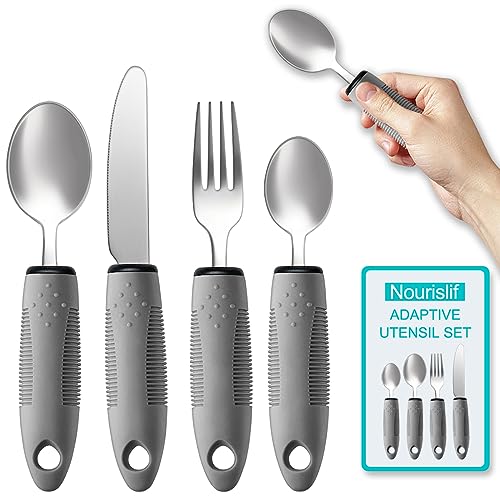
- Large contoured handle for steadier grip
- Includes spoon, fork, knife, and tablespoon
- Dishwasher-safe stainless steel construction
Best For: Adults needing a complete easy-grip utensil set
Right-Hand Offset Control
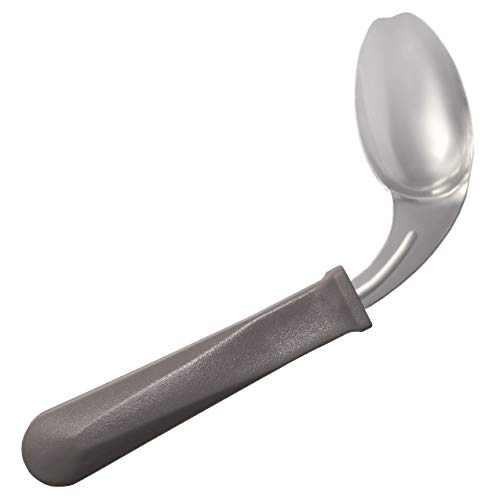
- Offset spoon helps with wrist and hand motion limits
- Right-handed design for more natural positioning
- Lightweight and dishwasher safe
Best For: Right-handed users needing better spoon positioning
Bendable Grip Support

- Swivels to different angles for custom use
- Non-slip handles plus adjustable straps
- Includes spoon and fork in a two-piece set
Best For: Users who need adjustable spoon positioning
Left-Handed Curved Utensil with Shield
Left-Handed Curved Utensil with Shield
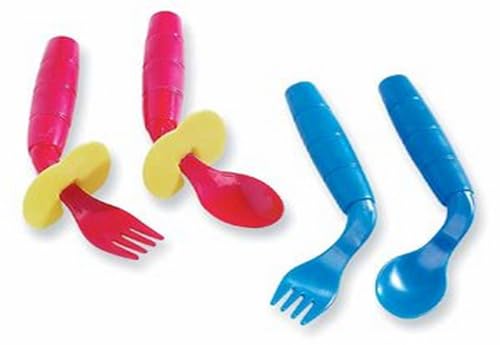
- Left-handed curved design
- Shield adds extra support
- Latex free; dishwasher safe
Best For: Left-handed users needing a simple supportive utensil
Swivel Soup Spoon for Shaky Hands
Swivel Soup Spoon for Shaky Hands

- Swivel head helps keep food on spoon
- Handle notch aids grip position
- Dishwasher safe up to 180º
Best For: Users with shaky hands or limited wrist and arm movement
Curved Handle Deep Bowl Spoon for Right Hand
Curved Handle Deep Bowl Spoon for Right Hand

- Curved handle supports natural grip
- Deep bowl helps hold food securely
- Right-hand stainless steel spoon
Best For: Right-handed users who need steadier self-feeding support
Flat-Edge Scooping Aid – Flat-Edge Spoon Set for Limited Dexterity
If you’re comparing an adaptive feeding spoon for autism or other daily-feeding support needs, this flat-edge spoon set is built around easier scooping and simpler handling. The bowl-friendly shape and flat bottom increase food contact, while the ergonomic spoon head is designed to help scoop food more efficiently with less effort.
Best For: Seniors, stroke recovery, and users with weak grip or limited dexterity who want an easier scooping utensil.
Pros:
- Flat bottom and 1″ wide tip help increase food contact for easier scooping
- Ergonomic spoon head is matched to the bowl profile
- Stainless steel construction is dishwasher safe
- Includes a table spoon and a coffee spoon for different uses
Cons:
- Non-weighted design may not suit users who need extra stability
- Primarily described as an adaptive aid for adults, not a child-specific feeding tool
This is a practical choice if your priority is reducing scooping effort rather than adding weight or special shields. The simple metal design is well suited to rehabilitation and everyday use where durability and easy cleaning matter.
Curved Hand-to-Mouth Aid – Curved Utensils with Optional Shield
For shoppers looking at an adaptive feeding spoon for autism, this curved utensil set stands out for its guided hand-to-mouth design and optional safety shield. The lightweight, built-up handle is made to be easier to hold, and the angled shape is specifically intended to promote greater success during feeding.
Best For: Children or adults with small hands, eating challenges, or a need for a more guided utensil path.
Pros:
- Curved, angled design promotes easier hand-to-mouth feeding
- Lightweight 3″ built-up handle is easier to hold
- Optional safety shield helps prevent the utensil from going too deep
- Offered in right- or left-handed options
Cons:
- Sold as a pair, so it may not fit buyers needing a single spoon only
- Color varies and specific color requests cannot be guaranteed
This is a thoughtful pick when guided motion and added mouth-depth protection matter more than a weighted design. Its occupational-therapist-informed shape makes it a strong fit for everyday practice and support.
Weighted Tremor Control Set – Weighted Spoon Fork Set for Steadier Eating
Adaptive Utensils Weighted Spoon Fork Set for Hand Tremors, Parkinson's & Arthritis
Check Price On AmazonIf you want an adaptive feeding spoon for autism-related mealtime support or other fine-motor needs, this weighted utensil set is built for steadier eating. The added weight is intended to counterbalance shaking hands, while the wide built-up handle and non-slip grip help make holding and controlling the utensils easier.
Best For: People with tremors, arthritis, weak grip, stroke recovery, or limited hand mobility who need extra steadiness.
Pros:
- Weighted construction is designed to help steady shaking hands
- Wide, ergonomic handle supports minimal finger dexterity
- Textured, non-slip grip works with wet or trembling hands
- Food-grade stainless steel set is dishwasher safe and travel-ready
Cons:
- Heavier design may not be ideal for users who prefer a very light utensil
- Includes both spoon and fork, which may be more than some buyers need
This set is the best fit when control and stability are the main goals. It combines weight, grip, and durability in a way that works well for daily meals, care facilities, and on-the-go use.
Right-Hand Curved Utensil – Curved Utensils with Shield
For a simple adaptive feeding spoon for autism or other mealtime support needs, this right-handed curved utensil set focuses on guided motion and mouth protection. The curved shape and included shield are designed to support easier feeding while helping prevent the utensil from entering the mouth too deeply.
Best For: Right-handed users who benefit from a curved utensil with an added shield for safer feeding.
Pros:
- Curved utensil design supports a guided feeding motion
- Included shield helps limit how far the utensil enters the mouth
- Simple one-count set keeps the setup straightforward
- Assorted colors may be appealing for some users
Cons:
- Right-handed only, so it won’t suit left-handed users
- Color cannot be selected in advance
This is a straightforward option if you specifically want a right-handed curved utensil with a built-in shield. It keeps the focus on controlled feeding rather than adding weight or extra handle bulk.
Built-Up Everyday Independence – Adaptive Utensils 4pcs Set
If you’re looking for an adaptive feeding spoon for autism or other grip challenges, this built-up utensil set is designed to make mealtimes steadier and easier. The enlarged 1.25-inch handle and lightweight stainless-steel build are aimed at improving control for people with weak hand grip, tremors, or limited dexterity.
Best For: Adults who want a full everyday utensil set with a larger, easier-to-hold handle.
Pros:
- Built-up, contoured handle helps improve grip and control.
- Includes a tablespoon, teaspoon, knife, and fork for a complete set.
- Made from rustproof stainless steel and is dishwasher safe.
- Designed for people with tremors, arthritis, Parkinson’s, or weak grip.
Cons:
- Not specifically an angled or bendable spoon design.
- Set is aimed at adults, so it may not suit smaller hands as well.
This is a practical pick if you want a simple, durable adaptive eating set rather than a specialty spoon. It focuses on grip support and everyday usability, which makes it a solid option for more independent meals.
Right-Hand Offset Control – Easy Offset Spoon
This adaptive feeding spoon for autism can also be useful when a person needs a more controlled, easier-to-hold spoon for limited hand mobility. The right-handed offset design and 4.5-inch plastic handle are meant to help users with arthritis, tremors, Parkinson’s, carpal tunnel, or dexterity issues feed more independently.
Best For: Right-handed users who need an offset spoon for better wrist and hand positioning.
Pros:
- Offset spoon design helps with limited wrist or hand range of motion.
- Right-handed layout supports more natural positioning for some users.
- Lightweight handle improves control during eating.
- Dishwasher safe up to 180 degrees for easier cleanup.
Cons:
- Only works for right-handed users.
- Sold as a single spoon, not a full utensil set.
If the goal is a spoon that changes the angle of use rather than just adding grip, this is a focused choice. It’s especially practical for therapy settings or for someone who needs a simple spoon with better positioning support.
Bendable Grip Support – Adjustable Adaptive Utensils
For anyone shopping for an adaptive feeding spoon for autism or other coordination needs, this bendable utensil set offers adjustable positioning plus extra grip support. The spoon and fork can be swiveled to different angles, while the non-slip handles and rubber straps are meant to help users with trembling or weak hands maintain more control.
Best For: Users who need a spoon that can be adjusted to different angles for easier feeding.
Pros:
- Bendable, swiveled design allows custom angle adjustment.
- Non-slip handles and adjustable rubber straps add stability.
- Includes both a spoon and fork in a two-piece set.
- Made from food-grade stainless steel and rubber.
Cons:
- Only includes two utensils, so it is not a full set.
- May be more specialized than a basic built-up spoon.
This is a strong option if angle adjustment matters more than a standard handle shape. The combination of bendable design and strap support makes it useful for users who need a more customized eating setup.
Left-Handed Curved Utensil with Shield – Left-Handed Curved Utensil with Shield
If you’re shopping for an adaptive feeding spoon for autism, this left-handed curved utensil is worth considering when a user needs a more guided grip and a shaped spoon that supports easier self-feeding. Its curved design and built-in shield are practical details for people who benefit from more control at mealtime, and it’s also latex free and dishwasher safe for everyday use.
Best For: Left-handed users who need a curved utensil with added support and easy cleanup.
Pros:
- Curved utensil design can help guide the hand during feeding.
- Built-in shield adds another layer of support for grip and positioning.
- Latex free and dishwasher safe for simpler daily care.
- Compact 7.9 x 6 x 1.7 inch size and lightweight build.
Cons:
- Designed specifically for left-handed use.
- No detailed bowl-depth or spill-control features are listed.
Overall, this is a straightforward adaptive utensil for users who need a left-handed option with a supportive shape. It focuses on basic practicality rather than advanced tremor control, so it fits best when simple guidance and easy maintenance matter most.
Swivel Soup Spoon for Shaky Hands – Swivel Soup Spoon for Shaky Hands
For an adaptive feeding spoon for autism, this swivel soup spoon offers a specialized design that helps keep food on the utensil when it’s turned at different angles. It’s made for users with limited muscle control, shaky hands, weak grip, or limited wrist and arm movement, but the notes also say it may not be appropriate for someone with severe tremors.
Best For: People who need a spoon that helps stabilize food during mealtime and have limited hand or wrist control.
Pros:
- Swivel design helps keep food on the spoon at varying angles.
- Notch in the handle may improve holding position.
- Dishwasher safe up to 180º for easier cleaning.
- Non-latex, BPA- and phthalate-free reusable plastic construction.
Cons:
- Not appropriate for someone with severe tremors.
- Plastic handle may feel less substantial than metal options.
This is a purpose-built adaptive utensil for users who need help with control at mealtime rather than a standard soup spoon. Its swivel mechanism is the main selling point, especially for people whose hand movement makes it hard to keep food centered on the spoon.
Curved Handle Deep Bowl Spoon for Right Hand – Curved Handle Deep Bowl Spoon for Right Hand
If you want an adaptive feeding spoon for autism that emphasizes simpler self-feeding support, this right-hand spoon uses a curved handle and a deep bowl to make scooping and carrying food more manageable. It’s designed for people with hand tremors or limited control, and the stainless steel build gives it a more traditional utensil feel.
Best For: Right-handed users who need a deeper spoon head and a curved grip for steadier meals.
Pros:
- Curved handle follows the natural grip of the hand.
- Deep spoon head holds food more securely than a standard spoon.
- Designed for users with tremors or limited control.
- Stainless steel material adds a familiar utensil feel.
Cons:
- Right-hand use only.
- No dishwasher safety or cleaning details are listed.
This spoon is best viewed as a simple adaptive option focused on grip comfort and spill reduction. It doesn’t add extra mechanisms, but the curved handle and deeper bowl can make daily meals easier for users who need a more forgiving utensil shape.
How We Picked the Best Adaptive Feeding Spoon for Autism
We looked for spoons and utensil sets that prioritize easier gripping, better wrist positioning, and steadier control during self-feeding. For an Adaptive Feeding Spoon for Autism, the most useful options typically balance comfort, stability, and ease of use rather than focusing on one feature alone.
We also considered whether each design may suit different hand strengths, motor planning needs, and dominant-hand preferences, since the best choice often depends on how the user actually eats.
Quick Comparison
Curved spoons can help guide food toward the mouth with less wrist rotation. Weighted utensils may feel steadier for tremors or shaky hands. Built-up handles can improve grip for users who need a larger surface to hold. Offset and swivel styles may reduce awkward arm positioning and make scooping easier.
Key Buying Factors for Adaptive Feeding Spoon for Autism
Grip and Handle Shape
A larger, textured, or built-up handle is often easier to hold than a standard narrow spoon. If fine motor control is limited, prioritize designs that make grasping simpler and more secure.
Angle and Spoon Orientation
Curved, angled, or offset spoons can support a more natural feeding motion. This may be especially helpful when wrist rotation is difficult or when the user benefits from a more guided path to the mouth.
Weight and Stability
Some users do better with a heavier spoon that feels more stable in the hand, while others prefer a lighter utensil that is easier to lift. The best Adaptive Feeding Spoon for Autism depends on whether the main challenge is control, fatigue, or coordination.
Handedness and Comfort
Left- and right-handed designs matter more than many shoppers expect. A spoon that matches the user’s dominant side can improve comfort and make self-feeding feel more natural.
Who Should Buy Which Adaptive Feeding Spoon for Autism?
If the user has shaky movements or tremors, consider weighted or stable-handled options. If wrist movement is limited, a curved or offset spoon may be a better fit. For users who need a simpler grip, choose a built-up handle. For those with side-specific needs, pick a left- or right-handed design to improve control and reduce frustration.
In short, the best choice is the one that fits the user’s hand strength, movement pattern, and comfort level at the table.