A stretch band can give a child a quiet way to push, pull, or move while seated. But the right choice depends on whether they need a band for chair legs or one they can use by hand.
These 10 options include single bands and multipacks for home or classroom use. Start with fit, resistance, and how easily the band can be used in the intended space.
Best 10 Autism Stretch Bands Picks for 2026
Best Color Variety
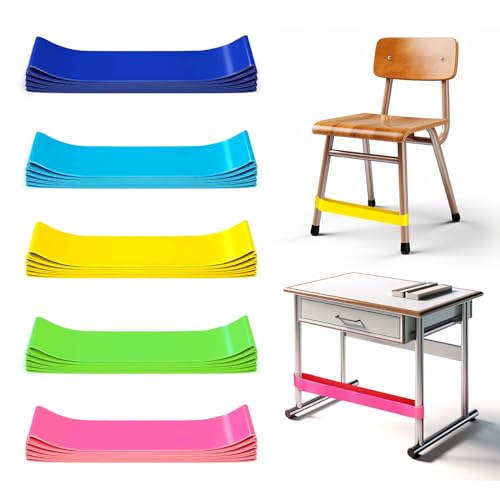
PLULON 15-Pack Chair Fidget Bands

- 15 bands in five colors
- Elastic TPE for seated foot movement
- Fits legs spaced over 10 inches apart
Best For: Outfitting multiple classroom or home chairs
Best Handheld Option
BouncyBand Stretch Band Focus Tool

- 30 by 6 inches; stretches past 46 inches
- Light-resistance silicone
- Portable for hands-on play
Best For: Take-along stretching and shape-making
Best Low-Key Chair Bands

- Six black chair-leg bands
- Elastic, wear-resistant TPE
- Made for seated foot movement
Best For: A smaller set of understated chair bands
Best for Shared Sensory Play

- Supports paired or solo play
- Soft, heavy-duty elastic fabric
- Useful for wrapping and crawling-through activities
Best For: Guided group or full-body sensory play
Best Multicolor Five-Pack

- Five multicolor TPE bands
- Fits legs spaced 12–30 inches apart
- Designed for minimal noise
Best For: Multiple classroom or home seating spots
Best Washable Rubber Option

- Washable rubber construction
- Fits front legs at least 10 inches apart
- Pack description has a quantity discrepancy
Best For: Portable bands for home, classroom, or office
Best Matching Blue Set

- Five matching blue TPE bands
- Fits legs spaced 12–30 inches apart
- Designed for minimal noise
Best For: Matching chair bands for home or classroom
Compact Three-Pack
Rubber Chair Bands for Fidgety Feet

- Three bands in three colors
- Fits front legs at least 10 inches apart
- Quiet, washable rubber
Best For: A few chairs at home or school
Mid-Size Classroom Pack

- 16 bands for multiple seats
- Fits 12–30-inch front-leg spacing
- Elastic, low-noise TPE
Best For: Small classrooms or several chairs
Large Classroom Pack
- 25 bands for larger setups
- Fits 12–30-inch front-leg spacing
- Low-noise, elastic TPE
Best For: Outfitting many classroom seats
Best Color Variety – PLULON 15-Pack Chair Fidget Bands
If you’re comparing autism stretch bands for classroom seating, this 15-pack offers five colors and enough bands to outfit multiple chairs or keep replacements handy. The TPE loops fit over chair or desk legs, giving fidgety feet a place to push without using a handheld tool.
Best For: Classrooms or households that need multiple colorful bands for seated foot movement.
Pros:
- 15 bands in five colors, with three of each color.
- Made from elastic TPE that is designed for easy installation and removal.
- Suitable for chair or desk legs spaced more than 10 inches apart.
Cons:
- Requires a compatible two-leg chair or desk setup.
- Designed for seated foot use rather than wrapping around the body.
Choose this pack when quantity and color choice matter most; check your furniture’s leg spacing before ordering.
Best Handheld Option – BouncyBand Stretch Band Focus Tool
Among autism stretch bands, this BouncyBand option is a portable, handheld choice rather than a chair attachment. Its soft silicone material offers light resistance for pulling, bending, twisting, and making shapes at home or school.
Best For: Kids who prefer a take-along stretch tool for hands-on sensory play.
Pros:
- Measures 30 by 6 inches and stretches to over 46 inches.
- Light resistance supports a range of stretching and shape-making activities.
- Portable design can be used in different settings.
Cons:
- Offers only one resistance level.
- Does not attach to chair legs for hands-free foot movement.
This is the more flexible pick for supervised movement breaks when a child wants to hold and manipulate the band rather than push against one under a seat.
Best Low-Key Chair Bands – 6-Pack Black Chair Bands
For shoppers seeking autism stretch bands that stay at a desk, this six-pack provides black TPE loops for chair-leg installation. They let seated kids move their feet against elastic resistance during classroom or home activities.
Best For: A smaller set of understated chair bands for seated foot movement.
Pros:
- Six bands provide extras for replacement or sharing.
- Black color offers a less colorful option.
- TPE material is described as elastic, wear-resistant, and easy to install and remove.
Cons:
- Only available in black in the supplied product details.
- Must be fitted to chair legs; it is not a handheld sensory band.
Pick this pack if you need several simple chair bands without the brighter colors of a mixed-color set.
Best for Shared Sensory Play – JXM Stretchy Resistance Band
This fabric option stands out among autism stretch bands because it is designed for both independent movement and two-child activities. Kids can stretch it together, or use it alone for wrapping, crawling-through, and cocoon-style play.
Best For: Guided sensory-room activities and children who enjoy full-body movement play.
Pros:
- Supports paired stretching and turn-taking activities.
- Can be used independently for several types of movement play.
- Soft elastic fabric has no hard parts or sharp edges.
Cons:
- Not described as a chair-leg band for seated foot fidgeting.
- The supplied details do not state the band’s unfolded dimensions.
Consider this one when you want an activity-focused fabric band for a classroom sensory space or home, rather than a fixed band under a desk.
Best Multicolor Five-Pack – WNSIRVY Chair Bands
If you’re shopping for autism stretch bands to use on chairs, this five-pack offers a discreet way for kids to move their feet while seated. The multicolor TPE bands fit across chair or desk legs spaced 12–30 inches apart.
Best For: Classrooms or homes that need multiple colors and bands for several seating spots.
Pros:
- Five bands provide extras for multiple chairs.
- Stretch over chair or desk legs without tools.
- Designed for minimal noise during use.
Cons:
- Requires front legs spaced 12–30 inches apart.
- Multicolor set may not suit buyers who want matching bands.
The wide stated fit range makes this a practical option for shared spaces; measure the chair legs before ordering.
Best Washable Rubber Option – Six-Pack Chair Bands
These rubber chair bands are an option for buyers comparing autism stretch bands for seated foot movement. The listing specifies a six-pack and describes the bands as quiet, washable, and portable for use at home, in class, or at the office.
Best For: Buyers who want washable rubber bands they can move between chairs.
Pros:
- Installs by stretching a band over two front chair legs.
- Washable rubber is suited to repeated use.
- Compact and lightweight for carrying between locations.
Cons:
- Requires front chair legs at least 10 inches apart.
- The listing says six bands but describes three colored bands, so the exact pack contents are unclear.
Its washable material stands out, but confirm the quantity and colors before buying if the precise contents matter.
Best Matching Blue Set – WNSIRVY Chair Bands
For buyers who prefer a matching look, these blue autism stretch bands come in a five-pack for chair-based foot movement. Made from TPE, they stretch over front chair or desk legs spaced 12–30 inches apart.
Best For: Classrooms or homes that want several matching blue chair bands.
Pros:
- Five blue bands create a consistent look across chairs.
- Tool-free installation over chair or desk legs.
- Designed to make minimal noise during use.
Cons:
- Requires legs spaced 12–30 inches apart.
- Only blue is specified for this set.
Choose this version over the multicolor five-pack if matching bands matter more than color variety, and check leg spacing first.
Compact Three-Pack – Rubber Chair Bands for Fidgety Feet
For shoppers comparing autism stretch bands for seated foot movement, this three-pack offers a simple option for home, classroom, or office chairs. Stretch a band over the two front legs to give restless feet a quiet, elastic surface to press against.
Best For: Families or teachers who want a small, portable set of chair bands.
Pros:
- Includes three rubber bands in red, blue, and green.
- Installs in seconds on chairs with front legs at least 10 inches apart.
- Washable, lightweight, and designed for quiet use.
Cons:
- Requires a chair with two suitable front legs.
- Three bands may not cover a larger classroom.
This is the more compact choice when you need bands for just a few seats. Check the chair-leg spacing before buying.
Mid-Size Classroom Pack – 16 Multicolor Chair Bands
If you need autism stretch bands for more than a few seats, this 16-pack provides chair-mounted bands for classrooms or home use. The stretchy bands go over two front chair or desk legs spaced 12 to 30 inches apart, creating a discreet way to move feet while seated.
Best For: Teachers or caregivers outfitting several compatible chairs without buying a larger 25-pack.
Pros:
- Includes 16 multicolor bands.
- Designed to install quickly on front legs spaced 12 to 30 inches apart.
- TPE construction is described as elastic and low-noise.
- Lists a three-year manufacturer warranty.
Cons:
- Won’t suit chairs outside the stated 12-to-30-inch leg spacing.
- A 16-pack could be more than a single household needs.
Its pack size makes sense for a small group or multiple rooms. Measure chair-leg spacing first rather than assuming every chair will fit.
Large Classroom Pack – 25 Multicolor Chair Bands
For larger setups, this 25-pack offers autism stretch bands that mount across the front legs of chairs or desks. The multicolor bands provide an elastic surface for foot movement and are described as producing minimal noise during use.
Best For: Classrooms or programs that need bands for many compatible seats.
Pros:
- Contains 25 bands for outfitting multiple chairs.
- Fits front-leg spacing from 12 to 30 inches.
- TPE bands are designed for elasticity and low-noise movement.
- Lists a three-year manufacturer warranty.
Cons:
- Requires compatible front legs spaced 12 to 30 inches apart.
- Twenty-five bands may be excessive for a few seats.
Choose this pack when coverage matters more than a compact purchase. Confirm the furniture dimensions before ordering for an entire room.
How We Picked These Autism Stretch Bands
This roundup covers two practical formats: chair bands that stretch between furniture legs for foot movement and handheld resistance bands for pulling or stretching. We considered format, pack size, likely setting, and the product details a buyer should verify before ordering. A band is a sensory tool, not a treatment for autism or a guarantee of improved focus. Individual comfort and preferences matter more than a claim on the packaging.
Quick Comparison: Which Format Fits?
Chair-mounted bands keep the movement point under a desk or chair and can suit children who want to push with their feet while seated. They need compatible furniture and enough tension to stay in place without getting in the way. Handheld bands offer more flexibility for supervised stretching or movement breaks, but they take up the user’s hands and may be less discreet during deskwork.
Single bands make sense when you are testing a child’s preference. Multipacks are more convenient for several chairs, shared spaces, or keeping replacements on hand. Compare the per-band cost, but do not choose a large pack before checking fit.
Key Buying Factors for Autism Stretch Bands
Furniture Fit and Placement
For chair bands, measure the distance between the legs where the band will sit and check their shape. A band that is too loose may slide; one stretched too far may be uncomfortable or wear quickly. Confirm it will not obstruct chair movement or create a tripping point for others.
Resistance and Sensory Preference
Some children enjoy firm pressure; others prefer a gentler stretch or dislike resistance altogether. Product listings do not always state tension in comparable terms, so begin with a manageable option when possible and watch how the child uses it. Movement should remain comfortable and controlled.
Durability, Supervision, and Setting
Check material details, care instructions, and any stated age guidance. Inspect bands regularly for cracks, fraying, or looseness, and replace damaged ones. Agree with teachers or caregivers on where and when a band can be used, especially in shared classrooms. Keep stretch bands away from the neck and follow the maker’s safety instructions.
Who Should Buy Which Autism Stretch Bands?
For a child who mainly moves their feet during seated tasks, start with a chair band after checking furniture measurements. For movement breaks away from a desk, consider a handheld band. If you are buying for one child whose preferences are still unclear, try a single option first. For a classroom with several suitable chairs, a multipack may simplify setup and replacements—but confirm the bands fit the furniture and that each child is comfortable using one.