The best educational jigsaw puzzles turn screen-free play into a hands-on lesson. Children can build vocabulary, spatial reasoning, geography knowledge, and science awareness while practicing patience and problem-solving.
Our 2026 roundup includes anatomy, map, solar system, dinosaur, transportation, and layered-body puzzles for preschoolers, school-age children, families, and adult learners. Use the guide below to match puzzle size, subject, and difficulty to the learner.
Best 10 Educational Jigsaw Puzzles Picks for 2026
Anatomy Explorer

- 100 pieces with a four-foot full-body design
- Medically accurate anatomy and uniquely shaped pieces
- Suitable for ages 6 and up
Best For: Hands-on anatomy learning at home or in the classroom
Map Master
Colorful United States Map Puzzle

- 1,000 pieces for ages 13 and up
- Features states, capitals, landmarks, and national parks
- Finished puzzle measures 26.8 by 18.9 inches
Best For: Teen and adult geography practice with family collaboration
Little Learner
Lift & Learn Human Body Puzzle

- 28-piece layered wooden puzzle for ages 3 and up
- Raised textures help little hands grip pieces
- Builds concentration, dexterity, and spatial awareness
Best For: Preschool anatomy introduction and tactile learning
World Traveler
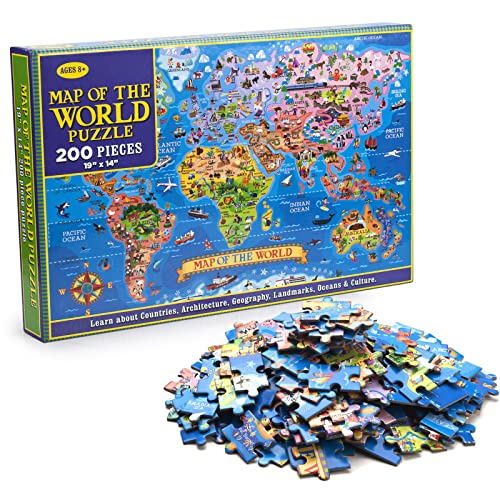
- Shows 65 countries, seven continents, and four oceans
- Includes landmarks, scenery, and animals
- 19-by-14-inch floor puzzle with storage box
Best For: Around age 8 and introductory world geography practice
Best Map-Based Pick

- 60-piece U.S. map with state-shaped pieces
- Includes state facts insert
- Supports geography and spatial skills
Best For: Children learning basic U.S. geography
Best Variety Set
Wooden Preschool Puzzle 4-Pack

- Four engaging themes in one set
- 20-piece wooden puzzles for preschoolers
- Trays and guides simplify storage
Best For: Young children building basic puzzle skills
Best Large-Piece Geography Pick
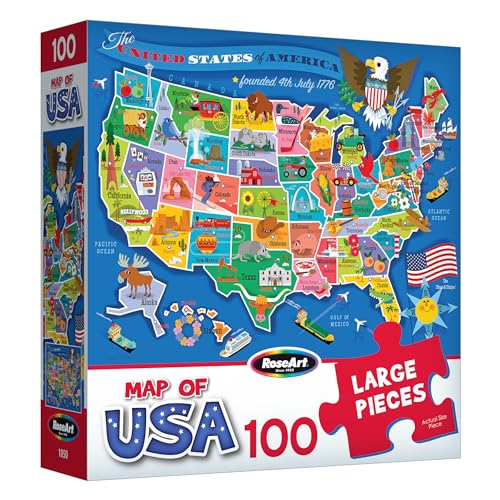
- 100 large pieces with all 50 states
- Includes landmarks and regional illustrations
- Finished puzzle measures 24 by 18 inches
Best For: Children ages 6+ exploring U.S. geography
Top Space Learning Pick

- Labeled planets support space learning
- Sturdy 100-piece design for small hands
- Builds focus, coordination, and problem-solving
Best For: Space-loving children ages 4-8
Best Heavy-Duty Pick
Four-Theme Educational Puzzle Bundle
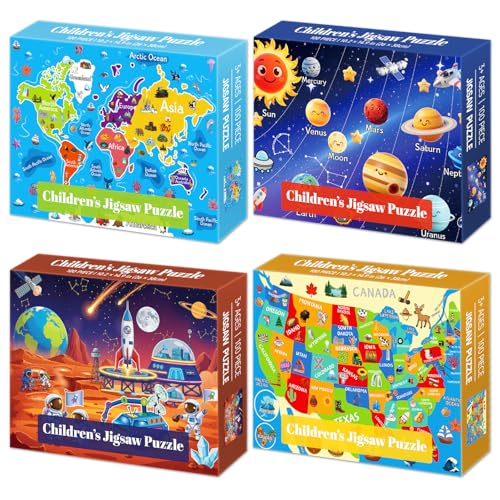
- Four 100-piece map and space puzzles
- Includes posters and helpful back lettering
- Supports memory, focus, and problem-solving
Best For: Families or classrooms wanting themed variety
Best Intergenerational Option
Unique-Piece Solar System Puzzle

- Unique pieces and included poster aid assembly
- Rounded corners suit young children
- Designed for child-and-grandparent collaboration
Best For: Shared space-themed play for ages 4-8
Anatomy Explorer – Human Body Floor Puzzle
This 100-piece educational jigsaw puzzle turns human anatomy into a hands-on floor activity. Its four-foot, medically accurate body illustration and uniquely shaped pieces help children explore major organs and body structures while assembling the puzzle.
Best For: Children ages 6 and up, classrooms, homeschool anatomy lessons, and families seeking a large educational floor puzzle.
Pros:
- Four-foot full-body design makes anatomy tangible at a child’s scale.
- Medically accurate cross-section covers major body parts and organs.
- Unique piece shapes create an additional assembly challenge.
- Includes a no-missing-pieces replacement guarantee.
Cons:
- The large completed puzzle needs substantial floor or display space.
- Its anatomy subject may be more specialized than a general children’s puzzle.
This is a strong choice when the goal is learning anatomy through an engaging, collaborative build rather than simply completing a decorative picture.
Map Master – Colorful United States Map Puzzle
This 1,000-piece educational jigsaw puzzle combines geography practice with a detailed USA map. Color-coded states, capitals, landmarks, national parks, mountain ranges, lakes, and state flags give families multiple details to discuss while building.
Best For: Ages 13 and up, adults, seniors, families, geography students, and collaborative tabletop puzzle sessions.
Pros:
- Displays all states with capitals, cities, activities, and state flags.
- Includes recognizable landmarks such as the Grand Canyon and Statue of Liberty.
- Large 26.8-by-18.9-inch finished size supports detailed map study.
- Unique cardboard pieces are designed to fit precisely.
Cons:
- The 1,000-piece count may be too difficult for younger children.
- Requires a sizeable tabletop and a longer completion session.
Choose this puzzle for an advanced map-themed activity that encourages state and capital recall while also providing the concentration and problem-solving benefits of traditional jigsaw play.
Little Learner – Lift & Learn Human Body Puzzle
This 28-piece educational jigsaw puzzle introduces young children to the layers of the human body through a raised wooden design. Bright colors, textured pieces, and a tray make it approachable for developing hands while encouraging concentration, spatial awareness, and fine-motor practice.
Best For: Children ages 3 and up, preschool learning, Montessori-style activities, and beginner human-body exploration.
Pros:
- Layered design gives children an introductory view of the human body.
- Raised textures make pieces easier for small hands to grasp.
- Wooden tray supports organized tabletop play.
- Safety-tested and made without BPA according to the supplied notes.
Cons:
- The 28-piece beginner format offers less detail than advanced anatomy puzzles.
- Its recommended age range is primarily early childhood.
This is a practical first anatomy puzzle for preschoolers, especially when tactile handling and developmental skill-building matter as much as subject knowledge.
World Traveler – 200-Piece World Map Puzzle
This 200-piece educational jigsaw puzzle makes geography approachable with a colorful world map featuring 65 countries, seven continents, four oceans, landmarks, natural scenery, and animals. The floor-puzzle format gives children an engaging way to practice recognition, memory, concentration, and patience.
Best For: Children around age 8, geography activities, map-learning games, and families introducing continents, oceans, and countries.
Pros:
- Covers continents, oceans, countries, landmarks, and natural features.
- Its 200-piece count offers more challenge than a preschool puzzle without reaching adult complexity.
- Thick, smooth paperboard pieces are designed to fit together securely.
- Includes a storage box and a guide printed on the box.
Cons:
- The listed recommended age is relatively narrow at around 8 years.
- Floor play requires a suitable open area.
For children ready to move beyond simple picture puzzles, this world map offers a balanced mix of geography discovery and independent problem-solving in a manageable format.
Best Map-Based Pick – USA State-Shaped Puzzle
MasterPieces 60 Piece Educational Jigsaw Puzzle for Kids - USA Map State Shaped - 16.5"x12.75"
Check Price On AmazonFor children ready to connect geography with hands-on play, this 60-piece option is one of the more focused educational jigsaw puzzles. Its state-shaped pieces, colorful map design, and included fact insert turn assembly into an introduction to U.S. geography while also encouraging screen-free problem solving.
Best For: Kids ages 4 and up who enjoy maps and are ready for a beginner-friendly 60-piece puzzle.
Pros:
- State-shaped pieces make the geography theme especially interactive.
- Includes a full-color insert with facts about each state.
- Thick recycled board, paper-backed pieces, and soy-based inks support repeated use.
- Supports spatial awareness, fine motor skills, logical thinking, and problem solving.
Cons:
- The single U.S. map theme may be less appealing to children who prefer animals or vehicles.
- Its 60-piece format may be too simple for experienced older puzzlers.
- The listed age guidance varies between 4+, 5–10, and 6+.
This is a strong choice when the learning goal is basic U.S. geography rather than a broad variety of themes. The state-shaped pieces add educational value without making the activity feel like a worksheet.
Best Variety Set – Wooden Preschool Puzzle 4-Pack
This four-pack offers a flexible introduction to educational jigsaw puzzles for preschoolers. With dinosaurs, animals, space, and transportation included, each 20-piece wooden puzzle gives young children a manageable way to practice matching, coordination, spatial awareness, and problem solving.
Best For: Preschool children ages 3–6 who benefit from short, varied puzzle sessions and simple 20-piece challenges.
Pros:
- Four themes provide variety: dinosaurs, animals, space, and transportation.
- Wooden trays with removable illustrated guides help with assembly and cleanup.
- Smooth, rounded edges and sturdy construction are designed for repeated handling.
- 20-piece puzzles support fine motor coordination, hand-eye coordination, and logical thinking.
Cons:
- Each puzzle has only 20 pieces, so it may not challenge advanced young puzzlers.
- The set is aimed at younger children and may feel basic to older kids.
- The supplied details describe mixed styles, so the visual presentation may vary.
The main advantage is variety: children can switch themes while staying with a consistent, approachable format. The wooden frames and storage trays also make this set practical for everyday preschool play.
Best Large-Piece Geography Pick – RoseArt USA Map Puzzle
For children who want a larger, more detailed geography challenge, this 100-piece USA map is a practical choice among educational jigsaw puzzles. Oversized pieces, colorful state illustrations, and a finished 24-by-18-inch layout help make the learning activity approachable while introducing states, landmarks, and regional icons.
Best For: Kids ages 6 and up who are ready for a larger map puzzle and want to explore U.S. geography through illustrations.
Pros:
- Features all 50 states, major landmarks, and regional illustrations.
- Large pieces are designed to be easier for young children to grasp.
- Supports map skills, memory, spatial awareness, and problem solving.
- Made in the USA with kid-safe finishes, according to the supplied notes.
Cons:
- The 100-piece layout may require more time and attention than a beginner puzzle.
- Its 24-by-18-inch finished size needs a reasonably large tabletop.
- The supplied age details list a general adult range as well as a recommended 6–10 range.
This puzzle is a good middle ground for children who have outgrown very simple designs but still benefit from large pieces. The illustrations provide visual cues that can make geography facts easier to remember.
Top Space Learning Pick – Solar System 100-Piece Puzzle
This 100-piece option is one of the more focused educational jigsaw puzzles for children ages 4 and up. Its completed solar system scene labels the planets, giving children a hands-on way to practice assembly while becoming familiar with Earth, Mars, Jupiter, Saturn, and the other planets.
Best For: Children ages 4-8 who enjoy space themes and benefit from a clearly labeled learning activity.
Pros:
- Displays all the planets with their names for interactive learning.
- Sturdy, interlocking pieces are sized for small hands.
- Supports concentration, hand-eye coordination, motor skills, patience, and problem-solving.
- Includes a missing-piece replacement or money-back guarantee.
Cons:
- It offers one solar system design rather than multiple themes.
- The 100-piece format may require adult help for younger children.
Choose this puzzle when the educational subject matters as much as the play value. The labeled artwork makes it especially suitable for introducing basic planet names during quiet tabletop activities.
Best Heavy-Duty Pick – Four-Theme Educational Puzzle Bundle
For families seeking variety, this four-pack of educational jigsaw puzzles combines USA map, world map, solar system, and Mars Adventure themes. Each 100-piece puzzle measures 10 by 15 inches when complete and includes a reference poster, making the set practical for repeated learning and play.
Best For: Families, classrooms, or siblings who want several geography and space-themed puzzles for children ages 4-10.
Pros:
- Includes four distinct 100-piece educational themes.
- Reference posters and letters on the backs can make assembly easier.
- Thickened cardboard, precision cutting, and bright printing support durability and clear visuals.
- Encourages observation, concentration, memory, creative thinking, and problem-solving.
Cons:
- The set requires storage for four separate puzzles.
- Some children may need guidance with the 100-piece format.
This is the strongest choice when one puzzle could quickly lose its appeal. The mix of maps and space topics gives children multiple ways to practice puzzle skills while exploring introductory geography and astronomy.
Best Intergenerational Option – Unique-Piece Solar System Puzzle
This 100-piece solar system puzzle is designed for children ages 4 and up, with a 15-by-10-inch completed size and a 1:1 reference poster. The manufacturer highlights uniquely shaped pieces, rounded corners, and a space theme that can support both independent play and collaborative grandparent-child activities.
Best For: Children ages 4-8 and families looking for a space-themed activity to share across generations.
Pros:
- Every piece is described as unique, which can help with identification during assembly.
- Includes a full-size poster for reference.
- Rounded, processed corners are designed with young children’s safety in mind.
- Can support concentration, motor skills, problem-solving, and family bonding.
Cons:
- The supplied description contains inconsistent theme wording, so buyers should verify the artwork before purchasing.
- At 100 pieces, it may be challenging for some younger children without assistance.
This puzzle stands out for shared play rather than a broad curriculum. Its manageable size, reference poster, and claimed unique-piece design make it a reasonable pick for a child and grandparent to assemble together.
How We Picked These Educational Jigsaw Puzzles
We evaluated the selected puzzles by educational subject, recommended age range, piece count, materials, format, and likely learning value. We also considered whether each design supports independent play, family participation, or a specific lesson such as anatomy, geography, or astronomy.
Piece count is only one measure of difficulty. Large floor puzzles may be easier to handle but require more space, while compact puzzles with smaller pieces can demand stronger visual discrimination and fine-motor control.
Quick Comparison
- Best for anatomy: Full-body and layered human-body puzzles.
- Best for geography: United States and world map puzzles.
- Best for space learning: Solar system and planet-themed designs.
- Best for preschool variety: Wooden four-packs with simple themed images.
- Best for family challenge: A 1,000-piece United States map puzzle.
- Best for floor play: Oversized 100- and 200-piece formats.
Key Buying Factors for Educational Jigsaw Puzzles
Age and Developmental Level
Start with the manufacturer’s age recommendation, then consider the child’s previous puzzle experience. Preschoolers often benefit from chunky wooden pieces, familiar pictures, and 20 to 60 pieces. Older children can generally handle 100-piece educational puzzles, while teens and adults may prefer more detailed maps with several hundred or 1,000 pieces.
Educational Subject and Accuracy
Choose a topic that matches the learner’s interests or current lessons. Anatomy puzzles should use clear labels or accurate body illustrations, while map puzzles are most useful when state, country, ocean, or landmark details are easy to read. Solar system puzzles can reinforce planet recognition and sequence, but check whether the artwork is intended as an educational diagram or simply a decorative space scene.
Piece Size, Materials, and Storage
Large pieces are easier for small hands and floor-based play. Wooden puzzles can offer durability, whereas cardboard puzzles are often lighter and easier to replace. Before buying, check the completed dimensions and storage method; oversized puzzles need a clear assembly area, and multi-pack sets need a box or pouch system to prevent pieces from mixing.
Solo Play Versus Shared Learning
A smaller, age-appropriate puzzle may support independent practice. Detailed maps and high-piece-count designs are better for guided learning or family sessions, where an adult can discuss locations, body systems, or planetary facts as the picture comes together.
Who Should Buy Which Educational Jigsaw Puzzles?
Buy a layered anatomy puzzle for children who learn best by seeing how parts fit together. Choose a United States map for learners interested in states, travel, or civics, and select a world map when geography study extends beyond North America. Solar system puzzles suit children curious about planets and space, while dinosaur, transportation, or mixed wooden sets work well for preschoolers who benefit from rotating through several themes.
For gifts, prioritize the recipient’s age, available floor or table space, and familiarity with puzzles over the highest piece count. Families seeking a longer shared challenge should consider the 1,000-piece map; younger children and beginners will usually get more value from large pieces, simpler imagery, or a multi-pack that provides several manageable activities.