Finding a vehicle restraint for a child with special needs starts with the child’s size, positioning needs, and ability to remain buckled—not a product label. A vest that works well for travel may be the wrong choice for a child who frequently unbuckles.
These six options span portable travel vests, mounted restraints, and a belt-conversion harness. Use the buying guide to narrow the field, then confirm fit and installation requirements before purchasing.
Best 6 Vehicle Safety Harness for Special Needs Child Picks for 2026
Rear-Zip Vehicle Vest

- Rear zipper and seat belt loops
- Medium size; fit measurements not supplied
- Mount sold separately
Best For: Buyers who can confirm fit and source the mount
Mount-Included Option

- Fits listed 25–32-inch chest range
- Rear zipper lock; three zipper options
- Mount included; no drilling required
Best For: Riders within the stated chest range needing a vest-and-mount setup
Portable Belt Positioner

- Listed for ages 3–6 and 30–55 lb
- 13.6-ounce seat belt-positioning vest
- No special-needs-specific feature listed
Best For: In-range children needing a portable belt-positioning vest
Best for Travel
RideSafer Travel Vest Gen 6 Large
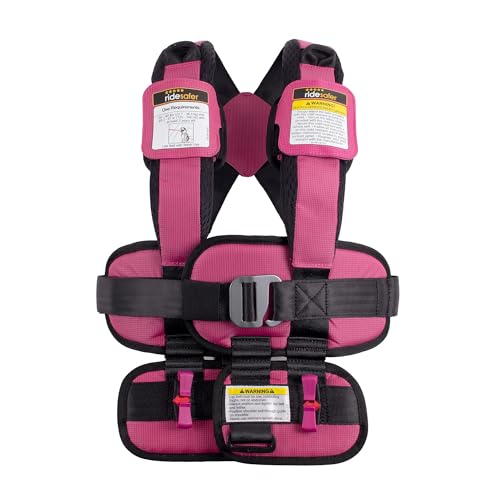
- 50–80 lb forward-facing range
- Under 1.5 lb; folds flat
- Meets or exceeds FMVSS 213B
Best For: Portable restraint for children who fit the stated range
Best for Growing Passengers

- Four-point securement from vehicle belts
- Dynamically tested for 66–168 lb
- Backpack-sized; no mount needed
Best For: Portable four-point securement across a broad tested weight range
Houdini-Proof Option

- Large personal-vehicle vest
- Listed with seat belt loops and mount
- Fit and installation details not supplied
Best For: Shoppers willing to verify specifications for a mounted vest
Rear-Zip Vehicle Vest – EZ-ON 303Z Medium
If you’re comparing a vehicle safety harness for special needs child transportation, the EZ-ON 303Z is a medium rear-zip vest with seat belt loops. Its listing describes it as a personal vehicle safety vest and says it meets an NHTSA regulation, but does not identify the specific regulation.
Best For: Buyers seeking a medium rear-zip vehicle vest who can verify fit and purchase the required mount separately.
Pros:
- Rear zipper closure.
- Seat belt loops are included in the vest design.
- Listed as durable and intended for personal vehicle transportation.
Cons:
- Mount is sold separately.
- Supplied information does not specify chest measurements or child sizing.
The separate mount and unspecified fit range are important checks before purchase, particularly when selecting a vest for a child.
Mount-Included Option – EZ-ON MAX2 Small Vest & Mount
For shoppers considering a vehicle safety harness for special needs child transportation, the EZ-ON MAX2 pairs a rear-zip vest with a mount. This small version lists a 25–32-inch chest circumference, giving you a concrete measurement to check before ordering.
Best For: A rider with a 25–32-inch chest whose caregiver wants the vest and mount together without drilling.
Pros:
- Vest and mount are included together.
- Rear zipper closure has a zipper lock, with three zipper options listed.
- Listing says no drilling is required and all connecting points are behind the seat.
Cons:
- Small size is limited to the listed 25–32-inch chest range.
- Hand wash only.
Check the chest measurement carefully and review how the behind-seat connections will work in your vehicle before choosing this setup.
Portable Belt Positioner – 801 Child Restraint Vest
If you’re searching for a vehicle safety harness for special needs child travel, the 801 is a compact, forward-facing seat belt-positioning vest rather than a rear-zip vehicle mount system. It is listed for ages 3–6, 30–55 pounds, and approximately 38–49 inches tall; its supplied details do not identify a special-needs-specific feature.
Best For: Children within the stated fit range whose caregivers need a portable, vehicle-seat-belt-positioned travel vest.
Pros:
- Weighs 13.6 ounces and is designed for portable use.
- Adjustable straps and three listed height positions.
- Listing states FMVSS 213 verification, UN R129 conformity, and CPSIA compliance.
- Triple-layer impact pads are included.
Cons:
- Limited to the stated weight and height ranges.
- No special-needs-specific restraint or mount feature is identified in the supplied details.
Its portability may appeal to traveling caregivers, but choose it by the child’s measurements and required restraint setup—not by the keyword alone.
Best for Travel – RideSafer Travel Vest Gen 6 Large
If you’re comparing a vehicle safety harness for special needs child travel, the RideSafer Travel Vest Gen 6 is a portable restraint worth considering for a child who fits its 50–80 lb range. The vest weighs under 1.5 lb and folds flat for rental cars, rideshares, or visits with grandparents.
Best For: Families seeking a lightweight, forward-facing restraint for a child who fits the stated weight range and can use a vehicle seat belt.
Pros:
- Meets or exceeds FMVSS 213B child-restraint standards.
- Folds flat for travel and is machine washable.
- Uses the vehicle seat belt without a complex installation.
Cons:
- Limited to children weighing 50–80 lb.
- The supplied details do not identify special-needs-specific positioning or escape-resistance features.
Choose this for portability rather than specialized behavioral support. Because children at the same weight can fit differently, check sizing with the manufacturer before ordering.
Best for Growing Passengers – EZ-ON 86Y
For shoppers seeking a vehicle safety harness for special needs child transportation, the EZ-ON 86Y offers an alternative to a bulky restraint. It converts a vehicle lap or lap/shoulder belt into a four-point securement and has been dynamically tested for passengers weighing 66–168 lb.
Best For: Families who need a portable four-point securement for a passenger within the stated tested weight range.
Pros:
- Works with lap or lap/shoulder belts to create four-point securement.
- Small enough to fit in a backpack for travel between vehicles.
- One-size-fits-most design accommodates a broad tested weight range.
Cons:
- Does not include a crotch strap.
- One size fits most does not guarantee an appropriate fit for every passenger.
The 86Y’s standout feature is its combination of portability and a 66–168 lb tested range. Confirm fit and whether a design without a crotch strap meets your passenger’s needs before buying.
Houdini-Proof Option – EZ-ON MAXPV Vest Large
If you’re researching a vehicle safety harness for special needs child transportation, the EZ-ON MAXPV is listed as a large personal-vehicle safety vest with seat belt loops and a mount. Its product title describes it as “Houdini Proof,” but the supplied information does not explain how that feature works.
Best For: Shoppers investigating a large safety vest with seat belt loops and a mount, subject to confirmation of fit and installation requirements.
Pros:
- Includes seat belt loops and a mount, according to the product title.
- Identified as a personal-vehicle transportation vest.
- Product title states that it meets NHTSA regulation.
Cons:
- No weight range, dimensions, or installation instructions were supplied.
- “Houdini Proof” is not supported by details about its retention features.
This vest may merit a closer look if those listed features match your needs, but verify its fit specifications, mounting procedure, and claimed compliance with the manufacturer before relying on it.
How We Picked the Best Vehicle Safety Harness for Special Needs Child
We grouped the six selected products by their stated use: portable belt-positioning vests, personal-vehicle vests with mounting components, a rear-zip vest, and a belt-conversion harness. Our comparison focuses on published size ranges where provided, how each restraint interacts with the vehicle seat belt, and the practical demands of fitting and installation. A product name or description alone cannot establish crash-test status, regulatory compliance, or suitability for a particular child. Check the current manufacturer instructions and labels before buying.
Quick Comparison
For travel and changing vehicles, start by comparing the 801 Child Restraint Vest and RideSafer Gen 6 with your child’s measurements and the vehicle’s belt setup; their portability does not make them interchangeable. The EZ-ON 303Z offers a rear-zip closure for families considering a less accessible fastening arrangement. The EZ-ON MAX2 and MAXPV include mounts, making installation requirements a central consideration; MAXPV is marketed for children who may try to escape a restraint. The EZ-ON 86Y is a belt-conversion harness rather than a vest, so evaluate it on its own installation and fit requirements.
Key Buying Factors for a Vehicle Safety Harness for Special Needs Child
Fit Comes First
Measure the child’s chest, height, and weight as required by the specific model. Do not rely on age, clothing size, or “one size fits most.” Confirm that the child falls within every stated limit and that the restraint positions the belt as directed. Consider growth room without buying an oversized harness.
Match the Child’s Needs to the Restraint
Identify the problem you are trying to solve: belt positioning, maintaining an upright posture, repeated unbuckling, or moving between vehicles. A rear zipper or harder-to-access closure may help with access to fasteners, but it is not a substitute for an individualized safety plan. Ask a child passenger safety technician experienced with adaptive restraints and the child’s clinical team to review complex positioning or behavioral needs.
Check Vehicle and Installation Requirements
Some systems rely on particular belt types, tether anchors, or mounting hardware. Confirm compatibility with every vehicle and seating position you plan to use, including school transport if relevant. Follow the manufacturer’s instructions for both the restraint and vehicle; never improvise attachment points or assume a portable vest can be used in every rideshare or rental car.
Who Should Buy Which Vehicle Safety Harness for Special Needs Child?
Choose a portable option if frequent vehicle changes are your main challenge and its fit and belt requirements are satisfied. Compare the 303Z if a rear closure addresses a specific fastening concern. Look at the MAX2 or MAXPV if a mounted setup fits your vehicle and the child’s needs; prioritize MAXPV only after confirming its features meet those needs. Consider the 86Y if a belt-conversion configuration is appropriate and you can meet its installation requirements. For any Vehicle Safety Harness for Special Needs Child, the best choice is the one that fits the child, works in the vehicle, and can be used correctly on every ride.