The best marble runs for homeschool turn playtime into a practical lesson in gravity, motion, engineering, sequencing, and problem-solving. The right set can also support fine-motor skills, creativity, and cooperative building.
This roundup compares 10 options, including magnetic tracks, large construction sets, glow-in-the-dark designs, motorized elevators, and early-learning marble activities. Use the guide below to match features, complexity, and durability to your learners.
Best 10 Marble Runs for Homeschool Picks for 2026
Best All-Around Set
Marble Mania 162-Piece Marble Run
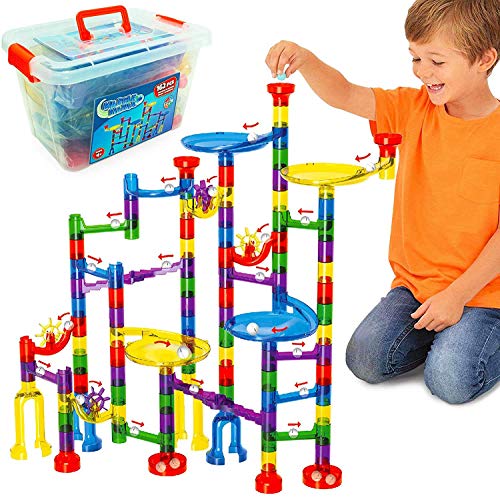
- 90 building pieces plus 72 marbles
- Includes guidebook and storage tub
- Designed for construction and problem-solving practice
Best For: Open-ended homeschool building play for ages 4 and up
Best for Early Handwriting
MarbleTracers Lowercase Letters

- 26 lowercase letter trays included
- Supports guided stroke formation
- Designed for ages 3 to 5
Best For: Preschool letter recognition and fine motor practice
Best Magnetic STEM Option
Tumble Trax Magnetic Marble Run
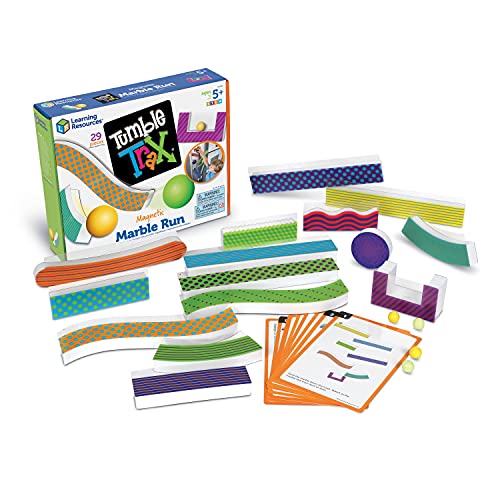
- Magnetic foam tracks for compatible surfaces
- Includes activity cards and challenges
- Explores gravity, momentum, and cause and effect
Best For: STEM design-and-test activities for ages 5 to 10
Best for Motorized Builds
MindWare Motorized Elevator Marble Run

- 82 track pieces and 15 marbles
- Includes a 13-piece motorized elevator
- Adds stunt elements and 3D building
Best For: Intricate homeschool construction and introductory physics play
Best Glow-in-the-Dark Pick

- 80-piece kit with sturdy, tight-fit track components
- Includes 15 glow-in-the-dark glass marbles
- Learning guide covers motion and aerodynamics
Best For: Ages 8+ and hands-on STEM experiments
Best Starter Set

- 50-piece magnetic building set for ages 3+
- Supports spatial awareness and early STEM skills
- Compatible with PicassoTiles expansion sets
Best For: Younger children beginning hands-on STEM play
Best for Continuous Builds

- 150-piece set with a motorized spiral lift
- Includes 30 marbles and 106 construction pieces
- Compatible with National Geographic non-magnetic sets
Best For: Ages 8+ and larger engineering-focused builds
Best with Extra Features

- Includes translucent pieces plus glow-in-the-dark marbles
- Eight bases support taller, sturdier builds
- Step-by-step booklet suits younger builders
Best For: Visual, open-ended homeschool STEM activities
Best for Clear Viewing
MaxTronic 109-Piece Marble Run

- Larger 16mm tubes and marbles improve visibility
- Includes 49 transparent pieces and 60 marbles
- Supports individual or collaborative STEM building
Best For: Track demonstrations and group homeschool projects
Best Budget-Friendly Learning Set
MaxTronic 110-Piece Marble Run

- Open-ended layouts support different skill levels
- Includes 50 pieces, 60 marbles, and a manual
- Useful for color, spatial, logic, and problem-solving activities
Best For: Flexible family or classroom marble run lessons
Best All-Around Set – Marble Mania 162-Piece Marble Run
For families comparing marble runs for homeschool, Marble Mania offers a substantial construction set with translucent pieces, plenty of marbles, and a storage tub for easier cleanup. Children ages 4 and up can follow the guidebook or create their own combinations while practicing construction, problem-solving, motor, and visual skills.
Best For: Open-ended building play for children ages 4 and up, especially families that want organized storage and many included pieces.
Pros:
- Includes 90 building pieces and 72 marbles for extended creative play.
- Translucent pieces let children watch the marbles travel through the run.
- Comes with a full-color guidebook and a sturdy storage tub.
Cons:
- The large number of pieces may require dedicated cleanup and storage space.
- The set includes both glass and plastic marbles, which may not suit every play environment.
This is a versatile choice when you want one comprehensive marble run for homeschool construction activities, guided builds, and independent experimentation.
Best for Early Handwriting – MarbleTracers Lowercase Letters
MarbleTracers adapts marble play into a focused early-writing activity, making it a practical option among marble runs for homeschool preschool lessons. Children ages 3 to 5 roll marbles through lowercase letter trays while following starting dots, molded stroke paths, and printed baselines.
Best For: Preschool homeschoolers practicing letter recognition, letter formation, and fine motor control through tactile play.
Pros:
- Includes 26 lowercase alphabet trays, 10 marbles, and an activity guide.
- Built-in guides support stroke order and letter formation.
- Combines visual, tactile, and movement-based learning.
Cons:
- This is a letter-tracing activity rather than a traditional multi-level marble run.
- The set focuses on lowercase letters, so additional materials may be needed for uppercase practice.
Choose this set when handwriting readiness is the priority and you want marble activity to reinforce alphabet learning rather than construction skills.
Best Magnetic STEM Option – Tumble Trax Magnetic Marble Run
Tumble Trax is a useful choice for marble runs for homeschool because its magnetic foam pieces can be rearranged on refrigerators, whiteboards, and other magnetic surfaces. Activity cards provide structured challenges, while open-ended designs let children explore gravity, momentum, cause and effect, planning, and fine motor skills.
Best For: STEM-focused homeschool lessons and children ages 5 to 10 who enjoy testing and redesigning track layouts.
Pros:
- Magnetic pieces attach securely to compatible surfaces.
- Activity cards provide guided maze and track challenges.
- Supports exploration of gravity, momentum, logic, and cause and effect.
Cons:
- Play depends on access to a suitable magnetic surface.
- The supplied notes do not specify the number of track pieces or marbles included.
Its magnetic format makes setup and redesign especially convenient for short homeschool STEM activities, classroom-style demonstrations, or repeated design-and-test experiments.
Best for Motorized Builds – MindWare Motorized Elevator Marble Run
MindWare Marble Run 110 Piece Building Set with 82 Track Pieces, 15 Marbles and Motorized Elevator
Check Price On AmazonThe MindWare Motorized Elevator set suits families seeking marble runs for homeschool with more elaborate construction and visible motion. It includes 82 track pieces, 15 marbles, stunt elements, and a 13-piece motorized elevator for building taller runs while introducing three-dimensional thinking and basic physics concepts.
Best For: Children ages 4 to 9 who are ready for taller, more intricate builds and an engaging motorized feature.
Pros:
- Includes a motorized elevator to return marbles to the top of the run.
- Features stunt pieces such as a spinner slide, marble jump, double funnel, and track splitter.
- Pieces connect and separate easily and are compatible with MindWare’s original Marble Run.
Cons:
- Requires two AA batteries, which are not included.
- With 15 marbles, it includes fewer marbles than some larger marble-run sets.
This set is a strong fit when the goal is to combine creative construction with dramatic motion and introductory physics discussion, provided batteries are available.
Best Glow-in-the-Dark Pick – Glow Marble Run
For homeschoolers seeking marble runs for homeschool, this National Geographic construction kit combines hands-on building with an introduction to motion and aerodynamics. Its 80 pieces include sturdy bases, action parts, smooth-run track pieces, and glow-in-the-dark glass marbles for repeatable design experiments.
Best For: Children ages 8 and up who enjoy STEM experiments and visually engaging marble runs.
Pros:
- Tight-fit pieces and five sturdy bases help keep structures together.
- Includes 15 glow-in-the-dark glass marbles in six colors.
- Learning guide covers physics, motion, aerodynamics, and construction experiments.
- Storage bag and marble pouch help organize the set.
Cons:
- Recommended for ages 8 and up, so it is not suited to younger children.
- Glass marbles require more careful handling than plastic alternatives.
This is a strong choice when a homeschool activity needs both creative construction and a clear STEM connection. The glow feature adds visual appeal, while the guide provides useful direction for structured learning.
Best Starter Set – Magnetic Marble Run
This PicassoTiles set is a practical entry point for families comparing marble runs for homeschool. The 50-piece magnetic construction system supports open-ended maze building while introducing spatial awareness, structural play, coordination, and basic physics concepts for children ages 3 and up.
Best For: Younger children who need an accessible, tactile introduction to STEM building and marble-run design.
Pros:
- Designed for children ages 3 and up.
- Embedded magnets support connected construction and creative layouts.
- Rounded, BPA-free plastic pieces are designed for a smooth, scratch-free feel.
- Compatible with PicassoTiles nano and full-sized sets for expansion.
Cons:
- The 50-piece collection is smaller than the larger kits in this roundup.
- Its educational guidance is described through play benefits rather than an included lesson guide.
Choose this set when accessibility and expandability matter most. It works well for early homeschool activities focused on building, fine-motor practice, visual tracking, and collaborative design.
Best for Continuous Builds – Motorized Marble Run
For homeschool families wanting marble runs for homeschool with a more advanced engineering challenge, this 150-piece National Geographic set adds a motorized spiral lift. The lift carries marbles nearly 20 inches back to the top, allowing children to explore recurring motion while designing larger track configurations.
Best For: Children ages 8 and up who are ready for larger builds, engineering challenges, and motion-based STEM lessons.
Pros:
- Motorized lift supports continuous marble runs.
- Includes 106 construction pieces, 30 marbles, and a 14-piece spiral lift.
- Learning guide covers physics, motion, and building tips.
- Compatible with National Geographic non-magnetic Glow-in-the-Dark Marble Runs.
Cons:
- Recommended for ages 8 and up.
- The motorized lift requires batteries or an appropriate power source, which is not specified in the supplied notes.
- The larger 4.1-pound kit may require more storage and setup space.
This is the most ambitious option here for lessons involving logical thinking, problem-solving, and engineering skills. Its motorized lift adds a distinctive continuous-motion element, while compatibility with another National Geographic set makes it suitable for future expansion.
Best with Extra Features – Meland 132-Piece Marble Run
For families comparing marble runs for homeschool, the Meland set offers a large collection of translucent building pieces, multiple marble types, and a visual glow-in-the-dark feature. Its included booklet can help younger children get started while older learners experiment with taller, custom designs.
Best For: Homeschoolers seeking an expandable, visually engaging marble run for ages 3–12 and parent-child building sessions.
Pros:
- Includes 102 translucent pieces, 20 regular glass marbles, and 10 glow-in-the-dark patterned marbles.
- Eight tower bases support taller and sturdier constructions.
- Interchangeable ABS pieces encourage repeated designs and hands-on STEM exploration.
- Instruction booklet provides step-by-step guidance for younger builders.
Cons:
- Glass marbles require close supervision around younger children.
- The large number of pieces may require organized storage between lessons.
This is a strong choice when you want one marble run to support guided activities, open-ended construction, and visual cause-and-effect demonstrations. The glow feature adds interest without replacing the core building experience.
Best for Clear Viewing – MaxTronic 109-Piece Marble Run
Among marble runs for homeschool, this MaxTronic kit stands out for its larger 16mm tubes and marbles, which make the rolling path easier to follow. The transparent construction and mix of glass and plastic marbles also support demonstrations of movement, sequencing, and track design.
Best For: Homeschool families wanting clear marble visibility, collaborative building, and a kit that can grow with children ages 3–12.
Pros:
- Uses larger 16mm tubes and marbles for clearer viewing and smoother rolling.
- Includes 49 transparent components and 60 marbles, split between glass and plastic.
- Secure-fitting ABS pieces with rounded edges are designed for repeated construction.
- Supports group play and custom designs across different skill levels.
Cons:
- Younger children may need help with assembly and instructions.
- The set includes fewer building components than some larger-piece kits.
The larger transparent parts make this a practical teaching aid when children need to see what happens at each stage of a run. Its mix of guided and custom building also works well for siblings or parent-child projects.
Best Budget-Friendly Learning Set – MaxTronic 110-Piece Marble Run
This MaxTronic kit is a straightforward option for homeschoolers who want marble runs for homeschool lessons without a fixed track layout. Its 50 building pieces and 60 marbles let younger children practice colors and construction while older learners explore directions, spatial reasoning, and problem solving.
Best For: Families and classrooms looking for an adaptable marble run for ages 3–12, from introductory building activities to more advanced track planning.
Pros:
- Open-ended design lets children build different shapes rather than follow one fixed layout.
- Includes 50 building pieces, 60 marbles, and an easy assembly manual.
- Can support age-leveled activities involving colors, numbers, spatial thinking, and logic.
- ABS construction has smooth edges and is described as ASTM-certified and CPSIA compliant.
Cons:
- Children should be supervised because the marbles can be swallowed.
- The 50-piece building set offers fewer construction pieces than the Meland kit.
Its flexible layout makes this a useful starter or classroom set when the goal is to adjust activities to different ages. The included manual provides structure, while the open-ended pieces leave room for independent experimentation.
How We Picked These Marble Runs for Homeschool
We focused on sets that support meaningful hands-on learning rather than simple novelty play. Our selection considers age range, piece count, construction style, track variety, marble size, storage, and opportunities to explore cause and effect. We also included different formats, from letter-based trays for younger learners to larger motorized systems for advanced building challenges.
Because homeschool setups vary, no single kit is ideal for every family. A compact magnetic set may suit short lessons and easy cleanup, while a 100-plus-piece system can support longer projects, group work, and repeated redesigns.
Quick Comparison
| Best for | Look for | Why it matters |
|---|---|---|
| Early learners | Large pieces and simple layouts | Easier handling and safer, more accessible play |
| STEM lessons | Multiple track types and connectors | Supports testing, iteration, and problem-solving |
| Independent building | Clear instructions and stable parts | Reduces frustration during self-directed work |
| Group projects | High piece counts and varied features | Gives several children roles and building options |
| Easy storage | Storage tubs or organized components | Makes frequent lessons more practical |
Key Buying Factors for Marble Runs for Homeschool
Age and Marble Size
Check the manufacturer’s age guidance before buying. Younger children generally benefit from larger components and straightforward tracks, while older students may prefer smaller construction pieces, tighter layouts, and more complex mechanisms. Always supervise children who may put marbles or small parts in their mouths.
Learning Goals
For a basic physics lesson, choose a set with ramps, turns, drops, and interchangeable sections. Letter trays can add literacy practice, while magnetic construction encourages spatial reasoning. Motorized elevators and moving features are useful for discussing energy, sequencing, and repeated motion.
Stability and Flexibility
Tracks should connect securely but remain easy to rearrange. Stable bases are especially important when children are testing height and speed. Flexible systems are better for open-ended projects, but kits with fewer connection types may be less frustrating for beginners.
Storage and Durability
A large set is only useful if its parts can be found and stored. Look for a tub, divided container, or a simple sorting routine. Durable plastic and connectors that tolerate repeated assembly are worthwhile for homeschool families using the kit often.
Who Should Buy Which Marble Runs for Homeschool?
Choose a large, versatile construction set for families planning extended STEM units or multi-child building sessions. Select a magnetic run when quick setup, easy repositioning, and compact storage are priorities. Letter-focused trays are a strong choice for preschool and early-elementary learners who need literacy practice alongside hands-on play.
Motorized or glow-in-the-dark models work well for older children who want more engaging demonstrations, while simpler 100-piece sets can provide a balanced introduction to design and gravity. If you are unsure, prioritize age-appropriate parts, secure connections, and enough track variety to rebuild the course several different ways.