The right communication board can make everyday needs, choices, and medical conversations easier to express when speaking is difficult or unavailable. This roundup compares 10 portable communication boards with picture symbols, letters, waterproof designs, lanyards, and multi-card formats.
Use the guide below to match board size, symbol style, durability, portability, and intended user before choosing a product for home, school, travel, therapy, or care settings.
Best 10 Portable Communication Boards Picks for 2026
Clinically Validated Pick

- Clinically validated picture-symbol board
- Attached marker and holder included
- Individually wrapped for infection prevention
Best For: Hospitals, clinics, and bedside patient care
Non-Slip Letter Chart
Adult QWERTY Communication Board

- 9.5-by-8-inch portable format
- Rubber backing resists slipping
- Large QWERTY letters and pain scale
Best For: Adults needing stable spelling support on the go
Multi-Pack Picture Cards
Eaasty 6-Piece Communication Set

- Six visual communication boards included
- Bright patterns and daily-life content
- Wipe-clean coated cardboard
Best For: Care teams needing backups or multiple copies
Voice-Output AAC Device

- 40 pre-installed picture phrases
- Five programmable recording buttons
- Adjustable volume and voice selection
Best For: Users needing customizable spoken AAC support
Best School Pick
Waterproof Classroom Communication Card

- School-focused pictures and words
- Rigid waterproof construction
- Includes breakaway lanyard
Best For: Classroom routines, transitions, and school activities
Best Large-Format Set
Extra-Large Nonverbal Communication Boards

- Four double-sided boards
- Large pictures and fonts
- Wipe-clean waterproof surface
Best For: Adults, patients, elderly users, and care settings
Best Everyday Pick
Kids Waterproof Visual Communication Card
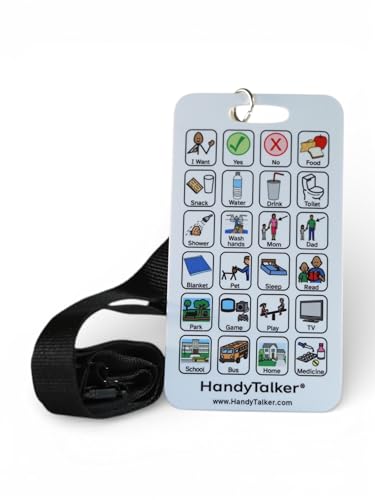
- Pictures and words for daily needs
- Waterproof lightweight plastic
- Lanyard included for portability
Best For: Home, school, travel, recreation, and outings
Most Versatile Set
Six-Theme Communication Placemat Boards

- Six boards cover feelings, needs, items, food, and general communication
- Colorful picture-and-word layouts support recognition
- Wipeable plastic suits repeated home, therapy, or care use
Best For: Users needing broad communication coverage in multiple settings
Best Compact Two-Board Set
Double-Sided Portable Communication Cards

- Includes two double-sided communication boards
- Compact and lightweight for care settings or travel
- Binding ring keeps the card set together
Best For: Users prioritizing portability and simple everyday communication
Best Four-Board Option
Portable Communication Boards for Adult Care

- Four specialized boards support needs, wants, and preferences
- Plastic construction is intended for frequent use
- Compact format suits hospitals, care homes, and daily routines
Best For: Adults with aphasia or stroke-related communication needs
Clinically Validated Pick – Vidatak EZ Board
The Vidatak EZ Board is a practical choice among portable communication boards for patient-care settings. Its picture-symbol layout, attached marker and holder, and dry-erase-style surface support clear communication while helping facilities maintain an organized bedside setup.
Best For: Hospitals, clinics, and caregivers seeking a clinically validated patient communication board with an attached writing system.
Pros:
- Designed by patients and nurses and clinically validated.
- Includes a marker and attached holder for convenient access.
- Individually wrapped to support infection-prevention practices.
- Used in thousands of healthcare facilities and recognized as an award-winning product.
Cons:
- The supplied details do not specify the board’s dimensions or portability features.
- Its healthcare-focused design may be more specialized than needed for casual home use.
With its established clinical focus and ready-to-use marker system, this board is a strong fit for structured patient communication. Buyers wanting detailed size information should confirm the specifications before ordering.
Non-Slip Letter Chart – Adult QWERTY Communication Board
This adult letter chart is one of the more travel-friendly portable communication boards for people who need a stable way to spell words or indicate discomfort. Its 9.5-by-8-inch format, rubber backing, and smooth vinyl surface are designed for lap, tray, tabletop, wheelchair, and backpack use.
Best For: Adults with aphasia, stroke recovery needs, speech difficulties, or limited verbal communication who prefer a QWERTY layout.
Pros:
- Non-slip rubber backing helps keep it in place on a lap, table, or tray.
- Large letters and smooth vinyl allow fingers to slide across the chart.
- Compact profile fits in a wheelchair side pocket or backpack without creasing.
- Adult-oriented design includes letters, words, symbols, and a pain scale.
Cons:
- The supplied version uses a QWERTY layout, which may not suit users who prefer ABC ordering.
- It is a letter-and-word chart rather than a voice-output device.
The sturdy, flexible construction makes this a useful option for on-the-go communication without extra accessories. Its main advantage is stability, especially when a board that slips from a lap or bedside tray would be frustrating.
Multi-Pack Picture Cards – Eaasty 6-Piece Communication Set
The Eaasty set offers six portable communication boards for patients who benefit from visual prompts. With bright patterns, daily-life communication content, and write-on, wipe-clean coated cardboard, it can provide replacement boards or multiple copies for use with doctors, caregivers, and family members.
Best For: Families, care teams, and facilities that need several visual communication cards for daily needs and healthcare conversations.
Pros:
- Six boards provide replacements or copies for different caregivers and locations.
- Bright colors and clear patterns support visual communication.
- 300g coated cardboard is thick, sturdy, and designed to resist tearing.
- Marker writing can be erased without scratching the printed surface.
Cons:
- Cardboard construction may be less durable than plastic or electronic alternatives.
- The supplied details do not specify the individual board dimensions or exact symbols.
- It does not provide spoken output.
This multipack is appealing when availability and backups matter more than advanced features. The wipe-clean surface adds flexibility, while the cardboard format keeps the set lightweight for distribution across care settings.
Voice-Output AAC Device – Joyreal Programmable Talker
The Joyreal AAC device expands beyond traditional portable communication boards by pairing picture-based prompts with recorded and pre-installed voice phrases. Four communication modules, adjustable volume, and five programmable buttons make it suited to users who need quick spoken choices for needs, feelings, and everyday interaction.
Best For: Non-speaking children and adults, including people with autism, aphasia, apraxia, or speech difficulties who may benefit from voice output.
Pros:
- Includes 40 pre-installed picture- and color-based phrases.
- Five programmable buttons allow personalized recorded messages.
- Offers four adjustable volume levels and male/female voice selection.
- Four visual modules cover basic expressions, feelings, personal needs, and wants.
Cons:
- Electronic operation introduces more complexity than a basic printed board.
- The supplied details do not specify battery type or battery life.
- It may be more equipment than needed for users who only require a simple visual chart.
For buyers seeking a portable communication aid with spoken output, this device provides more customization than static cards. Its combination of ready-made phrases and recordable buttons can support both immediate requests and personalized communication.
Best School Pick – Waterproof Classroom Communication Card
For school-focused portable communication boards, the HandyTalker School offers a compact, screen-free way to express common wants, needs, choices, and activities. Its rigid waterproof construction and included breakaway lanyard make it practical for classroom routines and transitions.
Best For: Students who need a portable visual communication tool for school and classroom activities.
Pros:
- Picture-and-word format supports quick pointing and recognition.
- Rigid, fiber-reinforced plastic is waterproof and resistant to bending, tearing, and peeling.
- Arrives ready to use with a breakaway lanyard; no batteries, apps, or charging required.
- Compact 3 x 5.5-inch design fits easily in small hands.
Cons:
- Its content is designed specifically around the school day rather than broader adult or medical needs.
- Small format may offer less viewing space than a full-size board.
This is a strong choice when durability, portability, and immediate classroom use matter most. The waterproof body is especially useful for spills, outdoor activities, and changing school environments.
Best Large-Format Set – Extra-Large Nonverbal Communication Boards
This four-piece set is a practical option for shoppers seeking large portable communication boards for adults, older users, stroke recovery, autism support, or care settings. The double-sided boards use pictures and large fonts to make everyday needs easier to indicate.
Best For: Adults, elderly users, patients, and care environments that benefit from large, wipe-clean visual boards.
Pros:
- Large 15 x 11-inch format and large fonts improve visibility.
- Double-sided design provides more daily communication content.
- Waterproof surface can be wiped clean and reused.
- Four boards support use across homes, care centers, ICU or postoperative settings, and hospice environments.
Cons:
- Much larger than pocket-size communication cards.
- Made from 600g cardboard, so it may not provide the same rigid-plastic durability as other options.
- The set may be more than needed for someone seeking a single everyday board.
Choose this set when visibility and coverage are more important than minimum size. Its large, double-sided format is well suited to shared use in healthcare, home-care, and rehabilitation settings.
Best Everyday Pick – Kids Waterproof Visual Communication Card
The HandyTalker Kids is a lightweight option for families looking for portable communication boards that work across home, school, travel, and recreation. Users point to familiar pictures and words to communicate wants, needs, choices, and feelings without relying on electronics.
Best For: Children who need a simple visual communication card for everyday activities and outings.
Pros:
- Compact 5.5 x 3-inch plastic card is easy to carry.
- Waterproof construction suits pools, playgrounds, travel, and outdoor activities.
- Included lanyard keeps the card nearby and accessible.
- Screen-free design requires no batteries, charging, apps, or Wi-Fi.
Cons:
- Its small format provides less display area than a large communication board.
- Content is positioned for children and everyday situations rather than specialized clinical use.
This card is a convenient everyday companion for children who benefit from consistent visual communication. Its durable, waterproof design makes it particularly useful when moving between home, school, travel, and recreation.
Most Versatile Set – Six-Theme Communication Placemat Boards
For shoppers comparing portable communication boards, this six-piece set stands out for its broad selection of themed layouts. The wipeable plastic boards cover feelings, personal needs, desired items, food, and general communication, making them suitable for home, therapy, hospital, or care settings.
Best For: Non-verbal children and adults, autism support, aphasia, speech therapy, and everyday communication across multiple settings.
Pros:
- Includes six boards with different communication themes.
- Colorful picture-and-word layouts support easier recognition and expression.
- Durable, smooth plastic is designed to resist tearing and bending.
- Wipeable surface allows convenient cleanup, including after food spills.
Cons:
- The large placemat-style dimensions may be less convenient for very small bags.
- The set may offer more themes than needed for users seeking only basic requests.
Choose this set if you want one portable communication board collection that addresses feelings, needs, choices, and food-related communication rather than a single-use layout.
Best Compact Two-Board Set – Double-Sided Portable Communication Cards
This set is a practical option for anyone seeking portable communication boards for hospitals, care homes, or everyday use. It includes two double-sided boards with a simple layout, plus a binding ring, so the set can be carried between locations and used for expressing needs, preferences, and requests for assistance.
Best For: Adults and children with communication difficulties who need a compact set for care environments, daily routines, or language-support activities.
Pros:
- Two double-sided boards provide multiple communication surfaces.
- Compact, lightweight design supports transport between locations.
- Simple layout is intended to be intuitive and easy to use.
- Binding ring helps keep the cards together.
Cons:
- With two boards, it offers fewer pieces than larger communication sets.
- The supplied details identify the material as cardstock, so it may be less robust than plastic alternatives.
This is a sensible pick when portability and straightforward everyday requests matter more than having a large collection of specialized themes.
Best Four-Board Option – Portable Communication Boards for Adult Care
For buyers who want portable communication boards designed around adult care needs, this four-board set offers a middle ground between a basic two-board kit and a larger collection. Its compact format is intended for hospitals, care homes, and daily use, with picture symbols to help users express needs, wants, preferences, and requests for assistance.
Best For: Adults with aphasia or stroke-related communication challenges, particularly in hospital, care-home, and everyday support environments.
Pros:
- Includes four specialized boards for a broader range of needs and wants.
- Compact dimensions support transport and use in different locations.
- Plastic construction is designed to withstand frequent use.
- Simple picture-symbol format is intended to be user-friendly.
Cons:
- The product is described primarily for adults, which may limit its fit for younger users.
- Its medium-sized format may provide less viewing space than larger placemat-style boards.
This set makes sense for caregivers seeking a focused, portable aid with more coverage than a two-board kit while keeping the format manageable for routine care.
How We Picked These Portable Communication Boards
We focused on practical features that affect daily usability: clear symbols, readable lettering, portable dimensions, durable construction, waterproofing, attachment options, and suitability for adults, children, stroke recovery, aphasia, autism, and other non-speaking situations. We also included both single-board designs and multi-card sets so buyers can choose between an all-purpose layout and a more flexible collection of visual prompts.
Because communication needs vary, no single board works best for everyone. A useful board should match the user’s vision, motor skills, vocabulary, reading ability, and typical communication environment.
Quick Comparison
- Best for hospitals and bedside use: Patient-focused picture and letter boards with large, familiar choices.
- Best for travel and daily carry: Compact boards, lanyard designs, and lightweight plastic or rigid waterproof formats.
- Best for children: Bright visual cards with simple symbols and flexible everyday vocabulary.
- Best for flexible communication: Multi-piece sets that let caregivers select or arrange cards for different routines.
- Best for users who can spell: Letter charts supplemented with yes/no, pain, comfort, and basic-needs symbols.
Key Buying Factors for Portable Communication Boards
Symbols, Letters, and Vocabulary
Picture symbols are often fastest for users with limited speech, while letter charts can support more precise messages. Look for boards that include essential needs such as pain, food, water, toileting, comfort, emotions, and assistance. For children, familiar routines and activity symbols may be more useful than a dense adult layout.
Size and Readability
A larger board is easier to see and point to, especially in bed or during therapy, but it may be less convenient to carry. Check symbol spacing, font size, contrast, and whether the user can point accurately with a finger, hand, or assistive pointer.
Durability and Cleaning
Plastic and rigid waterproof boards are practical for hospitals, schools, therapy rooms, and shared care environments. Laminated or wipe-clean surfaces help manage frequent handling. If the board will travel in a bag, consider rounded edges and construction that will not bend easily.
Portability and Access
Lanyards, compact card sets, and lightweight formats keep communication available when needed. A lanyard can help a child, caregiver, or staff member keep a board nearby, while separate cards may be easier to arrange around a particular routine.
Who Should Buy Which Portable Communication Boards?
Adults recovering from stroke or living with aphasia: Choose a readable board combining basic picture symbols with letters and essential-care phrases. Prioritize generous spacing and easy pointing.
Non-speaking autistic children and adults: Consider symbol-rich boards or card sets organized around daily activities, sensory needs, emotions, and choices. Select vocabulary appropriate to the user rather than relying only on age labels.
Schools, therapists, and caregivers: Waterproof rigid boards and multi-card sets are practical when several users or environments need different layouts. Keep one accessible in every location where communication support may be needed.
Hospital and care-home use: Pick a durable, wipe-clean design with high-contrast symbols, large text, and medical essentials. A simple layout is usually preferable when the user is tired, distressed, or recovering.