The best communication boards for classrooms give students a dependable way to express needs, choices, feelings, and responses without relying solely on speech. This roundup includes portable cards, laminated symbol boards, and electronic AAC options for different ages and support needs.
Use the buying guide below to compare portability, durability, symbol layouts, customization, and ease of use before choosing tools for a classroom, therapy setting, or home-school routine.
Best 10 Communication Boards for Classrooms Picks for 2026
Best Portable Classroom Pick
Waterproof Teacher Communication Card

- Picture-and-word format for common classroom communication
- Waterproof rigid construction for repeated use
- Compact design with breakaway lanyard
Best For: Portable classroom communication during lessons, transitions, and outings
Best Routine Practice Set
CHEFAN Autism Communication Cards

- 110 visual cards for needs, feelings, and routines
- Flip rings and retractable clip for portability
- Water-resistant, tear-resistant coated cardstock
Best For: Classroom, therapy, and home routine-based communication practice
Best Large-Format Set
Six Theme Communication Boards

- Six themed boards with words and matching images
- Large placemat-style format for visibility
- Wipeable plastic construction for easy cleanup
Best For: Shared classroom, therapy, hospital, and home-care communication areas
Best Multi-Location Bundle

- Six boards for placement in multiple locations
- Symbols cover needs, emotions, activities, and phrases
- Moderate 11.81-by-8.27-inch portable format
Best For: Classrooms and care settings needing communication support in several areas
Best Visual Choice
Step-by-Step Laminated Communication Board
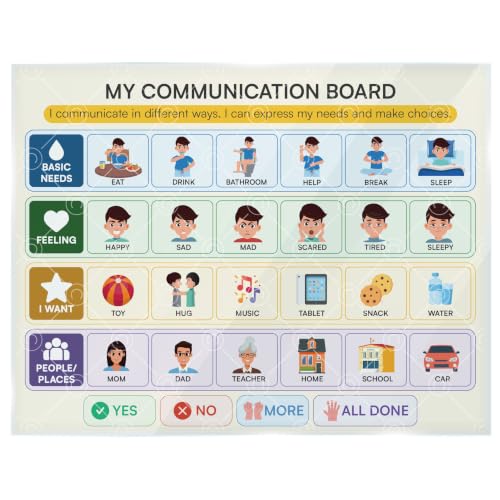
- Picture icons cover needs, feelings, routines, and school activities.
- Laminated and easy to clean.
- Lightweight for classroom, home, or therapy use.
Best For: Low-tech classroom communication and visual routine support
Best Multi-Location Set
Three-Piece Picture Symbol Boards

- Includes three boards for different locations.
- Covers daily needs, emotions, activities, and phrases.
- Compact and portable for classroom or community use.
Best For: Shared classrooms needing communication aids in multiple areas
Best Voice-Output Option
Brightway AAC Communication Device

- Offers 60 buttons and 10 programmable recording buttons.
- Includes adjustable volume and voice options.
- Large buttons support users with limited motor skills.
Best For: Classrooms needing voice output and personalized AAC messages
Best Picture-Card Set
Classroom Communication Boards for Kids

- 12 colorful boards for emotions, needs, school, play, and safety
- Large picture-and-text format for quick visual reference
- Reusable paper posters for walls or bulletin boards
Best For: Elementary classrooms and child-focused speech therapy
Best Interactive Option
Programmable AAC Communication Board

- 60 ready-to-talk phrases across four themed pages
- Eight buttons can be recorded with personalized messages
- Portable design with adjustable volume and large buttons
Best For: Classrooms needing spoken, personalized communication support
Best Adult-Care Set
Communication Boards for Older Students

- 12 adult-focused posters for needs, health, schedules, and safety
- Clear text and illustrations on large reusable paper boards
- Suitable for transition, rehabilitation, and care settings
Best For: Adult education, transition programs, and rehabilitation classrooms
Best Portable Classroom Pick – Waterproof Teacher Communication Card
For classrooms that need a compact, screen-free option, this teacher visual communication card is a practical choice among communication boards for classrooms. Its picture-and-word format covers common wants, needs, choices, feelings, and activities, helping students point to symbols during lessons and transitions.
Best For: Teachers and students who need a portable communication aid that can stay accessible throughout the school day.
Pros:
- Rigid, fiber-reinforced plastic is waterproof and designed to resist bending, tearing, and peeling.
- Picture symbols are paired with words for consistent visual support.
- Includes a breakaway lanyard and requires no batteries, charging, apps, or Wi-Fi.
- Compact 3-by-5.5-inch size is easy to carry between activities.
Cons:
- The compact format offers less space than a larger communication board.
- The supplied information describes one English classroom card rather than a multi-board set.
This is a strong everyday option when durability and portability matter most. The waterproof construction and lanyard make it especially convenient for classrooms, recess, field trips, and other activities where laminated paper cards may be less practical.
Best Routine Practice Set – CHEFAN Autism Communication Cards
With 110 visual cards covering daily situations, needs, feelings, and routines, this CHEFAN set gives teachers a broad collection of prompts for communication boards for classrooms. The cards can also support speech therapy, home practice, travel, and outdoor activities.
Best For: Classrooms, therapy sessions, and families seeking a larger visual-card set for daily routines and language practice.
Pros:
- Includes 110 cards covering common actions, needs, behaviors, and interactions.
- Clear, child-friendly illustrations support recognition and visual learning.
- Three flip rings and a retractable clip make the cards easy to carry or attach.
- Protective coating provides water and tear resistance for repeated use.
Cons:
- Card-based design may require organizing or selecting the most relevant cards for each student.
- The product details list both 110 pieces and a size entry of 104 pieces, so buyers may want to verify the exact contents.
This set is more versatile than a single-purpose board, particularly for teachers supporting several routines or communication goals. Its rings and clip help keep the cards together, while the broad selection allows for more individualized use.
Best Large-Format Set – Six Theme Communication Boards
This six-board set offers larger, placemat-style visuals for communication boards for classrooms and other care settings. Its themes include feelings, personal needs, desired items, food places, and general communication, with matching words and images for pointing-based interaction.
Best For: Classrooms, therapy centers, hospitals, and home-care spaces that can use larger wipeable boards in fixed locations.
Pros:
- Six boards address different themes, including emotions, needs, items, and food places.
- Large 16.93-by-12.6-inch format provides substantial viewing space.
- Plastic construction is sturdy, tear-resistant, and resistant to bending.
- Wipeable surface allows quick cleanup after regular use or spills.
Cons:
- The large placemat format is less pocket-portable than a small card set.
- The supplied notes do not specify customization options or classroom-specific symbols.
Choose this set when visibility and easy cleaning are more important than compact storage. Multiple themes can support different parts of the day, while the plastic surface is well suited to busy classroom, therapy, and care environments.
Best Multi-Location Bundle – Fuyoooo Picture Symbol Boards
The Fuyoooo bundle includes six picture-symbol boards designed for consistent access in more than one location. For classrooms using communication boards for classrooms, the variety of daily-life phrases, needs, emotions, and activities can help users point to relevant choices without relying on speech.
Best For: Schools, caregivers, and support settings that want multiple boards available around a classroom, home, or community routine.
Pros:
- Six boards allow placement in different locations for easier access.
- Symbols cover basic needs, emotions, activities, and commonly used phrases.
- Approximately 11.81-by-8.27-inch size balances viewing space with portability.
- Designed to support nonverbal adults and people with aphasia in daily interactions.
Cons:
- The supplied notes do not describe a wipeable or water-resistant surface.
- The boards are larger than pocket cards and may need dedicated storage or display space.
This is a practical choice for spreading communication support across several classroom stations or care areas. Its six-board format emphasizes availability and variety, while the moderate size keeps the boards manageable to transport when needed.
Best Visual Choice – Step-by-Step Laminated Communication Board
For classrooms seeking straightforward communication boards for classrooms, this laminated visual chart provides picture icons for common needs, feelings, people, places, and daily routines. Its 9 x 12-inch format is practical for desks, therapy areas, sensory rooms, or wall display.
Best For: Special education classrooms, speech therapy, autism support, and children learning independent picture-based communication.
Pros:
- Includes icons for food, drinks, emotions, family, school activities, bathroom needs, help, and routines.
- Laminated surface is easy to clean for everyday use.
- Supports communication for autism, speech delays, developmental disabilities, and language challenges.
- Lightweight design is convenient for home, school, or therapy settings.
Cons:
- Uses printed picture icons rather than recorded or customizable speech.
- Offers a fixed chart layout, so it may not suit users needing personalized vocabulary.
This is a practical, low-tech starting point for classrooms that want an immediately usable visual communication aid without setup or batteries.
Best Multi-Location Set – Three-Piece Picture Symbol Boards
This three-piece set is a flexible option for classrooms using communication boards for classrooms in more than one area. The compact picture-symbol boards can be placed in different locations, carried between activities, or kept available for users who communicate by pointing.
Best For: Classrooms, caregivers, and support settings that need multiple portable boards for daily needs, emotions, and activities.
Pros:
- Three boards allow placement in separate rooms or activity areas.
- Includes a range of symbols and commonly used phrases for daily communication.
- Compact size is convenient for transport at home or on outings.
- Supports nonverbal adults and people with aphasia as well as other communication needs.
Cons:
- Printed symbols do not provide voice output or programmable messages.
- The supplied notes do not specify a laminated or wipe-clean finish.
Choose this set when availability matters most: having three boards can reduce the need to move one communication aid between classroom stations, home, and community activities.
Best Voice-Output Option – Brightway AAC Communication Device
For classrooms that need more than printed symbols, this AAC device adds voice output to the communication-board category. It offers 60 buttons, 10 recordable buttons, adjustable volume, and large pressable controls for expressing needs, feelings, and everyday messages.
Best For: School, therapy, and home settings supporting nonverbal children or adults, speech delays, autism, dementia, or stroke recovery.
Pros:
- Provides 60 total buttons with preloaded everyday words and phrases.
- Ten programmable buttons allow personalized recorded messages.
- Adjustable volume and male/female voice options support different environments and preferences.
- Large, responsive buttons require minimal pressure and are portable between settings.
Cons:
- Heavier and thicker than a lightweight printed communication board.
- Requires setup and charging or power management typical of an electronic device, though battery details are not specified in the notes.
This is the strongest choice for classrooms where spoken output and customizable messages are more useful than a simple point-to-picture chart.
Best Picture-Card Set – Classroom Communication Boards for Kids
For classrooms supporting nonverbal children, these communication boards for classrooms provide a broad visual vocabulary in a 12-poster set. The bright illustrations and corresponding text cover feelings, needs, activities, school topics, safety, and more, making them useful for wall display or guided communication practice.
Best For: Elementary classrooms, autism support settings, speech therapy, and children who benefit from large visual prompts.
Pros:
- Includes 12 boards covering emotions, personal needs, items, play, school, schedules, safety, and other everyday topics.
- Large 11.4-by-8.3-inch format with colorful illustrations and text designed for easy reading.
- Can be posted on walls or bulletin boards and used at school, home, or in therapy.
- Copperplate paper is reusable and designed not to tear easily.
Cons:
- Paper posters are unframed, so classroom mounting supplies are needed.
- The set is designed for children and may be less suitable for older students who prefer adult-oriented visuals.
This is a practical choice when a classroom needs multiple visual communication zones rather than a single board. Its topic variety supports daily routines and basic expression, while the poster format works well for fixed, easy-to-see displays.
Best Interactive Option – Programmable AAC Communication Board
This portable AAC device offers a more interactive approach to communication boards for classrooms. It combines 60 ready-to-talk phrases with eight customizable recording buttons, four themed pages, adjustable volume, and large buttons for classroom, therapy, home, or travel use.
Best For: Classrooms and therapy settings that need spoken output, personalized phrases, and communication support that can move with the student.
Pros:
- Provides 60 pre-recorded phrases across emotions, social communication, self-care, health, needs, and wants.
- Eight programmable buttons allow teachers, parents, or therapists to record personalized messages.
- Four organized pages turn everyday scenarios into structured communication practice.
- Adjustable volume, rounded edges, and large buttons support use in different settings.
Cons:
- Only one device is included, so multiple students may need to share it.
- It requires manual operation and does not offer the fixed wall-display coverage of a multi-poster set.
This is the strongest fit when verbal output and personalization matter more than a static visual display. Its book-style design can support routine-based instruction, while the recording buttons help tailor communication to an individual student.
Best Adult-Care Set – Communication Boards for Older Students
For classrooms serving older students or adults with aphasia, these communication boards for classrooms offer age-appropriate topics that extend beyond basic classroom vocabulary. The 12 large posters address emotions, food, comfort, schedules, health monitoring, family, emergencies, and rights, with clear illustrations and text for visual support.
Best For: Transition programs, adult education, rehabilitation classrooms, hospital-based instruction, and settings supporting seniors or adults with communication difficulties.
Pros:
- Includes 12 adult-focused boards covering daily routines, food and drinks, health, comfort, family, safety, emergencies, and legal rights.
- Bright visuals and text are presented on approximately 11.4-by-8.3-inch posters for easy viewing.
- Useful across rehabilitation centers, assisted living facilities, adult day cares, hospitals, and private homes.
- Copperplate paper is reusable and designed for extended use.
Cons:
- Unframed paper posters require separate mounting or protection.
- The adult-focused content may not match the vocabulary needs of younger classroom learners.
This set fills a specific gap for programs that need respectful, practical visual communication for adults. Its health, schedule, safety, and rights topics make it especially relevant to transition and rehabilitation environments.
How We Picked the Best Communication Boards for Classrooms
We focused on products that can support everyday classroom communication, including requesting help, making choices, identifying emotions, participating in routines, and responding during lessons. The selection covers several formats: rigid lanyard cards, laminated visual charts, multi-card picture sets, and programmable electronic devices.
We also considered practical factors such as portability, cleaning, visibility, symbol variety, customization, and whether a product can work across classroom, therapy, and home environments. Because communication needs differ widely, no single board will suit every student.
Quick Comparison
| Type | Best For | Main Advantage | Potential Limitation |
|---|---|---|---|
| Rigid lanyard board | Quick access during transitions | Portable and screen-free | Limited vocabulary space |
| Laminated visual chart | Classroom routines and choices | Easy to see and clean | Less flexible than a device |
| Picture-card set | Custom activities and therapy | Cards can be arranged by need | Cards may be misplaced |
| Programmable AAC device | Frequent, repeated communication | Customizable output | Requires charging and setup |
Key Buying Factors for Communication Boards for Classrooms
Vocabulary and Layout
Look for symbols that match the student’s communication goals and current ability. Core words such as “more,” “stop,” “help,” “go,” and “finished” are useful across activities, while topic-specific cards can support lunch, play, toileting, or academic work. A simple, uncluttered layout may be more effective for a beginner.
Durability and Hygiene
Classroom materials should tolerate frequent handling, spills, and cleaning. Laminated cards and rigid plastic boards are generally more practical for shared or high-use areas than thin paper cards. Check whether pieces can be wiped safely and whether small parts create a storage or supervision concern.
Portability and Access
A board is most helpful when it is available when communication is needed. Lanyards, compact card rings, and lightweight boards work well for transitions. Larger charts can provide more vocabulary but may be better suited to a desk, wall, or designated communication station.
Customization and Independence
Choose a format that lets staff add relevant names, routines, preferences, or classroom phrases when necessary. Programmable devices may offer greater flexibility, while fixed picture boards can be faster to introduce and easier for multiple adults to use consistently.
Who Should Buy Which Communication Boards for Classrooms?
Choose a portable rigid board or compact card set for students who need quick access during transitions, recess, arrival, or community activities. Laminated charts are a strong fit for classroom routines, visual schedules, and structured speech-therapy practice. Multi-card picture sets suit teachers and therapists who want to select or rearrange symbols for different lessons.
Consider a programmable AAC device when a student communicates frequently, needs more vocabulary, or benefits from recorded or synthesized speech. For students with more complex communication needs, use these products as classroom supports rather than substitutes for an individualized AAC assessment and implementation plan. Teachers, families, speech-language pathologists, and support staff should coordinate vocabulary, prompting, and modeling so the same communication system is available consistently.