The best busy boards for classrooms turn everyday skills into focused, hands-on learning. From switches and latches to zippers, buttons, puzzles, and storytelling pieces, these activity boards can support fine-motor practice, sensory exploration, and independent play.
We selected 10 classroom-friendly options across different ages, formats, themes, and installation styles so teachers can match each board to their available space, learning goals, and supervision needs.
Best 10 Busy Boards for Classrooms Picks for 2026
Best Wall-Mounted Train Board
18-in-1 Sensory Activity Panels

- 18 activities across five panels
- Supports shared and independent play
- Includes mounting hardware
Best For: Classrooms and daycares building a permanent sensory activity station
Best Compact Light-Up Board

- 24 LEDs controlled by 13 switches
- Compact and travel-friendly
- Made for individual exploration
Best For: Portable quiet-time and sensory use with toddlers
Best Elephant Wall Board
14-in-1 Classroom Sensory Panel

- 14 activities across four panels
- Supports group or independent play
- Mounts on a wall or separates into panels
Best For: Preschool classrooms wanting a themed shared sensory station
Best Dressing Skills Set

- Nine dressing and fastening activities
- Supports fine motor development
- Portable and battery-free
Best For: Preschool and special education life-skills instruction
Best Life-Skills Pick
Craftstory Montessori Busy Board

- Eight-in-one dressing-skill activities
- Enlarged features for little hands
- Nylon, portable classroom design
Best For: Preschool life-skills practice
Best for Younger Learners
ABERLLS Wooden Sensory Busy Board
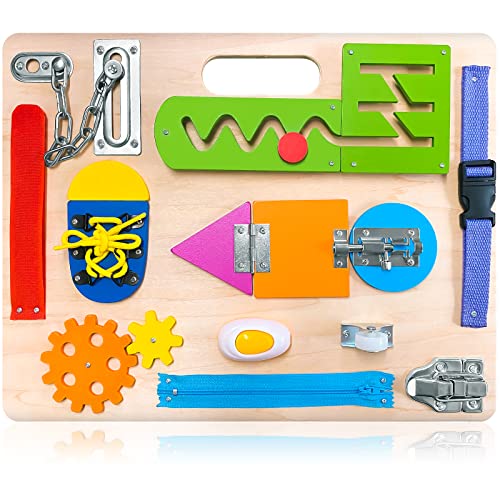
- Recommended from 12 months
- Includes fasteners, gears, and switches
- Compact smooth-wood design
Best For: Toddler fine-motor exploration
Best Group Activity
204-Piece Forest Felt Story Board

- Large 40-by-28-inch play surface
- Includes 204 forest-themed felt pieces
- Encourages storytelling and teamwork
Best For: Collaborative preschool storytelling
Compact Hands-On Pick

- 10 switches with varied sensory activities
- Smooth natural-wood construction
- Portable format for travel or individual use
Best For: Portable individual activities and fine-motor practice
Wall-Mounted Whale Pick

- Space-saving wall-mounted format
- Activities support sensory and early learning skills
- Includes screws and smooth rounded wood construction
Best For: Indoor classroom, daycare, nursery, or playroom activity walls
Group Activity Wall Pick
9-Piece Hexagon Activity Wall Set

- Nine panels provide multiple activity stations
- Covers sensory, motor, cognitive, and music skills
- Includes 20 screws for wall mounting
Best For: Classroom or daycare activity walls and group play
Best Wall-Mounted Train Board – 18-in-1 Sensory Activity Panels
For classrooms seeking busy boards for classrooms that support group exploration, this VEVOR train-shaped wall board combines 18 hands-on activities across five panels. It offers screen-free practice with clocks, sliders, fasteners, puzzles, and other early-learning tasks.
Best For: Daycares, classrooms, and activity centers that need a wall-mounted board for independent or shared play.
Pros:
- Includes 18 activities, including a clock, number puzzle, xylophone, gears, laces, zipper, buckle, and shape matching.
- Supports sensory development, focus, coordination, and early life skills.
- Can be installed as a wall display or used as separate panels with included hardware.
- Uses E1-grade MDF, water-based paint, rounded edges, and firmly attached parts.
Cons:
- Recommended for children ages 3 and up, so it may not suit younger toddler groups.
- Its wall-mounted format requires installation space and hardware setup.
- At 11.4 pounds, it is less convenient to move frequently than a compact board.
Choose this model when a classroom needs broad activity variety and a colorful, shared learning station rather than a portable toy.
Best Compact Light-Up Board – 37-in-1 Switch Activity Toy
For teachers comparing busy boards for classrooms that need portability, this compact RichBoy board combines switches, lights, and other sensory features in a small wooden design. Its 37-in-1 format is suited to quiet individual exploration and travel between learning spaces.
Best For: One-child quiet-time use, special education settings, travel, and classrooms supporting sensory exploration.
Pros:
- Features 37 activities with 13 switches controlling 24 LED lights.
- Compact 6.7-by-5.3-inch size fits small hands, backpacks, cars, and airplane travel.
- Rounded, smoothly sanded wood construction is designed for young children.
- Tool-operated battery compartment helps prevent access to the batteries.
Cons:
- Designed for one player, so it is not intended as a group activity station.
- Requires two AAA batteries, which are not included.
- The recommended age range is 12 months to 3 years, limiting use with older preschoolers.
This is a practical pick when portability, switch practice, and light-based sensory engagement matter more than a large shared classroom display.
Best Elephant Wall Board – 14-in-1 Classroom Sensory Panel
This elephant-shaped VEVOR board is a focused option for classrooms looking for busy boards for classrooms with varied tactile and early-learning activities. Four panels provide practice with fasteners, sorting, counting, sound, and visual tracking in a wall-mounted format.
Best For: Daycares, preschool classrooms, and activity centers wanting a sturdy shared sensory station with 14 activities.
Pros:
- Includes sliders, sensory fabric, gears, laces, zipper, buckle, clock, abacus, xylophone, and bead sorting.
- Supports independent play as well as shared activities for multiple children.
- Can be mounted on a flat wall or arranged as separate panels.
- Includes mounting hardware and uses E1-grade MDF with water-based paint and rounded edges.
Cons:
- Recommended for ages 3 and up.
- Wall installation requires appropriate space and assembly.
- With 14 activities, it offers fewer activity options than the 18-in-1 train version.
Its elephant theme and moderate activity count make it a balanced choice for classrooms that want a permanent, visually engaging board without the larger train set’s full activity list.
Best Dressing Skills Set – Nine-Piece Life Skills Boards
For educators choosing busy boards for classrooms with a life-skills focus, this nine-piece dressing set offers direct practice with buttons, buckles, zippers, snaps, laces, ties, hooks, and clasps. The small pieces are designed for hands-on instruction and portable practice.
Best For: Preschool, kindergarten, daycare, and special education classrooms teaching dressing and shoe-tying skills.
Pros:
- Provides nine colors and nine dressing-skill activities.
- Builds finger flexibility, fine motor skills, hand-eye coordination, and problem-solving.
- Portable size works for classroom practice, trips, cars, and airplanes.
- Requires no batteries and can support children with sensory processing needs, hyperactivity, or autism.
Cons:
- The supplied material specification lists paper rather than wood or MDF.
- It focuses on dressing skills rather than offering broader sensory activities such as music or number puzzles.
- Small pieces may be less suitable for group wall-display use than mounted activity panels.
Select this set when the classroom goal is practical self-care instruction and repeated fastening practice, especially in small-group or one-to-one lessons.
Best Life-Skills Pick – Craftstory Montessori Busy Board
For classrooms seeking busy boards for classrooms that build practical independence, the Craftstory Montessori Busy Board focuses on everyday dressing skills. Its manual activities include tying, buttoning, snapping, lacing, zipping, buckling, and hook-and-loop practice.
Best For: Preschool classrooms, life-skills practice, speech therapy, and other learning settings serving children ages 3 and up.
Pros:
- Offers multiple dressing-skill activities in one compact board.
- Enlarged buttons, buttonholes, and wide flaps are designed for little hands.
- Nylon construction is intended to withstand regular use.
- Portable design works for classroom activities or travel.
Cons:
- It is designed for one player at a time.
- The manufacturer recommends it for ages 36 months to 9 years, so it is not suited to infant classrooms.
This is a practical choice when the classroom goal is repeated, hands-on practice with dressing-related tasks rather than open-ended group play.
Best for Younger Learners – ABERLLS Wooden Sensory Busy Board
The ABERLLS Wooden Sensory Busy Board is one of the more age-focused busy boards for classrooms, with activities intended for children from about 12 months. Latches, Velcro, switches, gears, a key lock, zipper, and button provide simple hands-on exploration.
Best For: Early-learning rooms and toddler settings that need a compact board for fine-motor and basic problem-solving practice.
Pros:
- Recommended for children 12 months and up.
- Includes varied tactile activities for gripping, turning, fastening, and manipulating.
- Smooth natural wood and smooth edges are designed with young children in mind.
- Lightweight, compact format is suitable for travel or individual use.
Cons:
- It is intended for one player at a time.
- The small activity format may be less suitable for group instruction.
- Its age range is primarily geared toward toddlers rather than older preschoolers.
Choose this board when your classroom serves younger children and needs an individual sensory activity that introduces familiar fasteners and hand movements.
Best Group Activity – 204-Piece Forest Felt Story Board
For classrooms looking beyond individual fine-motor tasks, this 204-piece felt story set offers a large shared surface. The 40-by-28-inch forest-themed board supports arranging animals and scenery, creating stories, and collaborative play on a wall or floor.
Best For: Preschool classrooms seeking a large, open-ended storytelling and cooperation activity for children ages 3 and up.
Pros:
- Large surface can accommodate several children playing together.
- Includes 204 felt pieces with animals, plants, and other forest-themed elements.
- Supports imagination, storytelling, communication, coordination, and teamwork.
- Two hook holes allow wall hanging, while the included storage bucket helps organize pieces.
Cons:
- The set contains small parts and requires supervision for children under three.
- The large size needs substantially more storage space than a handheld board.
- It is primarily a felt storytelling activity, not a fastener-practice board.
This set is a strong classroom option when shared creative play and narrative building matter more than practicing buttons, zippers, or other dressing skills.
Compact Hands-On Pick – Montessori Wooden Busy Board
For buyers comparing busy boards for classrooms, this compact wooden option offers 10 hands-on switches and activities in a portable format. Its lacing, unlocking, spinning music box, and LED-light activities support fine-motor practice and screen-free engagement. Note that it requires two AAA batteries, which are not included.
Best For: Portable individual activities, travel, and classrooms seeking a compact sensory board.
Pros:
- Includes 10 switches and varied hands-on activities.
- Supports dexterity, hand-eye coordination, and cognitive development.
- Made from smooth natural wood with rounded, splinter-free construction.
- Compact 9.8-by-9.8-inch format is easy to carry.
Cons:
- Requires two AAA batteries, not included.
- Its single-board design is better suited to individual use than group play.
This is a practical choice when portability and varied fine-motor activities matter most. For a classroom, plan for one-at-a-time use or provide multiple boards for a larger group.
Wall-Mounted Whale Pick – Whale Activity Wall Panel
This whale-shaped panel is a space-saving option for buyers seeking busy boards for classrooms, daycare rooms, nurseries, or playrooms. It mounts to the wall and combines sensory and learning activities intended to encourage color recognition, hand-eye coordination, concentration, clock reading, and motor skills.
Best For: Permanent indoor activity areas in classrooms, daycares, nurseries, and playrooms.
Pros:
- Wall-mountable design helps conserve floor space.
- Includes screws for installation.
- Supports sensory exploration, clock reading, color recognition, and coordination.
- Durable wood has smooth surfaces and rounded edges.
Cons:
- Designed for indoor use and requires wall installation.
- May offer less activity variety than the nine-panel set.
- The supplied age details are inconsistent, so verify suitability before purchase.
The whale design can add visual interest while creating a dedicated hands-on station. It is especially useful where floor space is limited, provided the wall can be securely prepared for installation.
Group Activity Wall Pick – 9-Piece Hexagon Activity Wall Set
For classrooms that need more than one activity station, this nine-piece hexagon set provides a broader wall-mounted setup. The panels offer activities focused on colors, shapes, hand-eye coordination, motor skills, logical thinking, clocks, and early musical awareness, making it a versatile choice for busy boards for classrooms.
Best For: Classrooms, preschools, and daycare spaces that need multiple wall activities for individual or group play.
Pros:
- Includes nine wooden activity panels and 20 screws.
- Supports a wide range of sensory, motor, cognitive, and early music skills.
- Hexagonal panels can create an engaging decorative activity wall.
- Suitable for individual play, group interaction, and cooperative learning.
Cons:
- Requires secure wall installation and more planning than a tabletop board.
- Occupies more wall area than a single panel.
- No batteries are included or required, so all activities are manual.
This is the strongest fit of the three for a dedicated classroom activity zone because its multiple panels can support varied exploration and group use. Measure the wall and plan the layout before installing the set.
How We Picked the Best Busy Boards for Classrooms
We compared these activity boards by examining their intended age range, number and variety of activities, material design, portability, installation style, and likely classroom use. We looked for products that encourage practical skills rather than offering only passive entertainment. Wall-mounted panels can work well in activity centers and shared spaces, while portable boards and felt sets are easier to rotate between stations or send home.
Because classroom needs vary, this list includes both compact skill-building boards and larger multi-activity panels. Teachers should still inspect every product for loose parts, small components, sharp edges, and hardware before introducing it to students.
Quick Comparison
| Type | Best For | Classroom Advantage |
|---|---|---|
| Wall-mounted panels | Shared activity centers | Keep floor and table space clear |
| Portable wooden boards | Small-group practice | Easy to move between stations |
| Dress-up skill boards | Practical life lessons | Build buttoning, zipping, lacing, and tying skills |
| Felt story sets | Language and imaginative play | Support sequencing, vocabulary, and storytelling |
| Modular panels | Custom classroom layouts | Allow activity zones to expand over time |
Key Buying Factors for Busy Boards for Classrooms
Age and Developmental Level
Choose activities that are challenging without being frustrating. Simple switches, large latches, and basic cause-and-effect features suit younger learners, while older preschoolers may benefit from zippers, tying, sequencing, and more complex locks.
Safety and Supervision
Check the manufacturer’s age guidance and inspect hardware regularly. Small detachable pieces may present a choking risk, and wall panels should be mounted securely at an accessible height. Use closer supervision when introducing unfamiliar mechanisms.
Format and Installation
Wall boards are useful in permanent learning centers but require suitable mounting surfaces and installation time. Portable boards are more flexible for classrooms with rotating stations. Consider storage, cleaning, and whether multiple children can use the activity without crowding.
Learning Goals and Durability
Match the board to your lesson plan: practical-life boards support dressing skills, sensory panels encourage exploration, and story sets promote communication. Durable wood, reinforced stitching, smooth edges, and securely attached components matter when products will receive frequent classroom use.
Who Should Buy Which Busy Boards for Classrooms?
Choose a wall-mounted VEVOR, Whale, or hexagon panel set when you want a visible, space-efficient activity center for repeated use. A RichBoy, ABERLLS, Craftstory, or general Montessori wooden board is better for table stations, one-on-one practice, or flexible room layouts. Pick the dress-and-lacing board for practical-life instruction focused on buttons, buckles, zippers, snaps, and shoelaces. The felt animal story set is the strongest fit for preschool storytelling, vocabulary work, sequencing, and imaginative group activities.
Before buying, measure the intended area, confirm the recommended age range, and decide whether the board will be used independently or with an adult. The right choice is the one that fits your classroom routine as well as your students’ current developmental goals.