Wooden sensory wall panels turn everyday play into hands-on learning, giving children opportunities to practice fine-motor skills, coordination, problem-solving, and independent exploration.
We compared 10 popular options, from compact themed boards to larger multi-panel activity centers, with attention to variety, construction, installation, and age-appropriate design.
Best 10 Wooden Sensory Wall Panels Picks for 2026
Best Interactive Rocket Panel
VEVOR 13-in-1 Rocket Busy Board
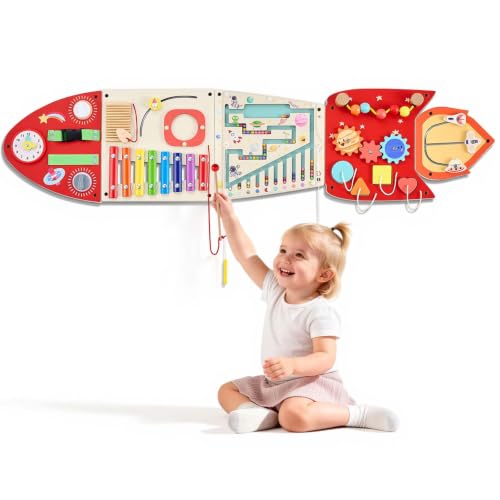
- 13 hands-on activities across five panels
- Mount together or use separately
- Supports fine-motor and practical-life play
Best For: Screen-free play in homes, classrooms, and daycares
Best Double-Sided Texture Set
13-Piece Hexagon Sensory Wall Panels

- Seven double-sided wood panels
- Six removable texture pads plus mirror
- Adds finger-tracing and tactile play
Best For: Sensory corners and early pre-writing practice
Best Modular Busy Board
Pillowhale Tangram Activity Panels

- 12 Montessori-style activities
- Six panels form multiple shapes
- Can be floor-play or wall-mounted
Best For: Creative layouts and cooperative preschool play
Best Large Texture Collection
24-Piece Replaceable Texture Panels

- 24-piece modular tactile system
- Seven fabric textures for comparison
- Replaceable pads and rear hanging loops
Best For: Sensory rooms, classrooms, and tactile-focused play
Best All-Around Activity Variety
Olakids 11-in-1 Unicorn Sensory Wall

- 11 activities spanning music, matching, counting, and fine-motor play
- Water-based paint, rounded edges, and TSCA-certified materials
- Large wall-mounted plywood design for ages 3 to 8
Best For: Families wanting one colorful activity center with broad developmental coverage
Best for Daycares and Playrooms
AthomBear Dinosaur Wall Busy Board

- 12 activities for fine-motor, sensory, musical, and early math play
- Solid wood with rounded edges and a non-toxic finish
- Pre-drilled mounting design in a large 56-by-20-inch format
Best For: Shared playrooms, classrooms, and daycares needing a durable wall station
Best for Sensory Texture Exploration
Double-Sided Montessori Sensory Wall Panel

- Six reversible boards with varied textures and tracking activities
- 13-piece set includes a mirror, positioning board, and storage bag
- Modular design suits calm-down corners, classrooms, and sensory rooms
Best For: Texture-focused sensory play with flexible home, classroom, or travel use
Best Playroom Feature

- Four activity types in one wall-mounted board
- Rounded wood design with child-safe paint
- Space-saving crocodile shape
Best For: Playrooms, nurseries, and daycare areas needing one colorful activity panel
Best for Pretend Play

- Five themed pretend-play stations
- Designed for cooperative group play
- Includes mounting screws and instructions
Best For: Preschool playrooms, daycares, and classrooms with room for a larger wall installation
Best Multi-Panel Set

- Nine panels with varied learning activities
- Includes 20 screws for wall mounting
- Supports individual and group play
Best For: Classrooms, daycares, and playrooms building a larger activity wall
Best Interactive Rocket Panel – VEVOR 13-in-1 Rocket Busy Board
For buyers seeking wooden sensory wall panels with broader activity variety, this rocket-shaped VEVOR board combines 13 hands-on features in five panels. It is designed for indoor mounting in homes, classrooms, daycares, and activity centers.
Best For: Toddlers and preschoolers who benefit from practical-life activities, fine-motor practice, and screen-free independent or group play.
Pros:
- Includes 13 activities, including latches, sliders, a clock, xylophone, bead maze, gears, and shape matching.
- Five panels can be mounted together or used separately.
- Smooth surfaces, rounded edges, water-based paint, and included mounting hardware support straightforward installation.
Cons:
- The manufacturer recommends it for children ages 3 and up.
- It is intended for indoor use.
- The rocket design may be less flexible for buyers wanting a neutral wall display.
This is a practical choice when activity variety matters more than a dedicated tactile-texture focus. Its compact, colorful format and group-play potential suit busy learning environments.
Best Double-Sided Texture Set – 13-Piece Hexagon Sensory Wall Panels
This 13-piece set is a strong option for wooden sensory wall panels when tactile exploration and finger tracing are priorities. Its double-sided hexagon panels offer texture pads on one side and carved tracing paths on the other.
Best For: Playrooms, classrooms, and activity corners focused on tactile awareness, pre-writing practice, and hand-eye coordination.
Pros:
- Includes seven double-sided pine wood panels, six removable texture pads, and an acrylic mirror.
- Combines multiple tactile textures with carved finger-tracing patterns.
- Includes a positioning template, mounting supplies, and a felt storage bag for the pads.
Cons:
- The set emphasizes tactile and tracing activities rather than a wide range of mechanical games.
- Installation still requires wall mounting and arranging the panels.
The reversible design gives this set more than one way to play and makes it useful for rotating sensory activities. It is particularly appealing for early finger control and visual exploration.
Best Modular Busy Board – Pillowhale Tangram Activity Panels
Pillowhale’s tangram-inspired set gives wooden sensory wall panels a flexible layout. Six interlocking panels can be arranged into shapes such as houses, boats, and rockets, used on the floor, or mounted on a wall.
Best For: Families, preschools, and waiting rooms that want varied Montessori activities with opportunities for creative arrangement and group play.
Pros:
- Offers 12 activities, including gears, bead maze, shape sorter, clock, and xylophone.
- Six panels support multiple configurations and can be used on the floor or wall.
- Smooth edges, non-toxic paint, pre-drilled holes, and included screws simplify setup.
Cons:
- The supplied notes specify indoor use only.
- Its modular shape arrangements may require more setup than a fixed panel.
- The product is recommended for toddlers and preschoolers, so it may not suit older children seeking more advanced activities.
This set stands out for buyers who want both a busy board and an open-ended construction element. The combination of rearrangeable panels and familiar learning activities encourages repeat play.
Best Large Texture Collection – 24-Piece Replaceable Texture Panels
For buyers comparing wooden sensory wall panels primarily for tactile variety, this 24-piece system offers interchangeable pads and seven fabric textures. Its modular hexagon format can be arranged in different layouts for homes, classrooms, daycares, and sensory rooms.
Best For: Sensory-focused spaces that need varied touch experiences, repeatable fine-motor practice, and a wall-ready modular display.
Pros:
- Includes 24 pieces with interchangeable texture pads and tactile exploration surfaces.
- Seven fabric textures encourage children to compare and identify different sensory inputs.
- Rounded corners, reinforced stitching, sturdy construction, and rear hanging loops support wall mounting.
Cons:
- Surface clean only; the pads are not machine washable.
- It focuses on tactile exploration rather than clock, music, or shape-sorting activities.
- The manufacturer recommends it for children ages 3 and up.
This is the most texture-centered option in the group and offers plenty of pieces for creating a customized sensory wall. It is a good fit when touch-based exploration is the main buying priority.
Best All-Around Activity Variety – Olakids 11-in-1 Unicorn Sensory Wall
For families seeking wooden sensory wall panels with broad developmental coverage, the Olakids Sensory Wall combines 11 manual activities in one wall-mounted station. It includes fine-motor, matching, early math, music, and time-related activities for children ages 3 to 8.
Best For: Homes wanting a colorful, all-in-one Montessori activity center for preschool and early school-age children.
Pros:
- Offers 11 activities, including a bead maze, xylophone, clock, gears, shape matching, and sliders.
- Water-based, non-toxic, odorless paint and rounded edges support kid-friendly use.
- TSCA-certified materials and firmly connected components provide added reassurance.
- Requires no batteries and supports fine motor skills, hand-eye coordination, and spatial awareness.
Cons:
- The manufacturer recommends it for ages 3 and up, so it may not suit younger toddlers.
- At about 53.54 inches wide and 4.54 kg, installation requires dedicated wall space.
The Olakids is a strong choice when variety matters most. Its unicorn-themed design and wide activity mix can keep children engaged, though buyers should measure carefully before mounting this large plywood panel.
Best for Daycares and Playrooms – AthomBear Dinosaur Wall Busy Board
The AthomBear Dinosaur Wall Busy Board is a substantial option among wooden sensory wall panels, pairing 12 hands-on stations with a solid-wood construction. Its vertical format helps move activities off the floor while supporting fine-motor, sensory, early math, musical, and problem-solving play.
Best For: Daycares, classrooms, and playrooms that need a durable, high-capacity wall activity center for children ages 2 to 6.
Pros:
- Includes 12 activities such as gears, a clock dial, xylophone, bead counter, and two magnetic bead mazes.
- Solid wood, smooth surfaces, rounded edges, and a non-toxic finish support regular use.
- Pre-drilled holes and included screws and dowels are designed for installation in about 30 minutes after marking the wall.
- Its 56-by-20-inch format reclaims floor space and is intended for repeated daily use.
Cons:
- A power drill and stud finder are not included.
- Its large, heavy-duty design may be more than needed for a small home play area.
- Supervision is advised during initial sessions, particularly for children around the lower recommended age.
With its solid-wood build and extensive activity selection, this dinosaur-themed panel is particularly well suited to shared environments. Plan for secure wall mounting and enough clearance for children to use the stations comfortably.
Best for Sensory Texture Exploration – Double-Sided Montessori Sensory Wall Panel
This double-sided wooden sensory wall panel takes a modular approach to tactile play. The 13-piece set includes six reversible boards, a mirror board, a positioning board, sensory mats, and a portable felt storage bag for home, classroom, or travel use.
Best For: Calm-down corners, sensory rooms, classrooms, and families seeking texture-focused and fine-motor activities.
Pros:
- Six reversible boards provide varied textures on the front and tracking activities on the back.
- A mirror board adds visual and self-discovery play.
- Modular, wall-mounted design can help create a space-saving learning nook.
- Portable felt storage bag supports taking the sensory mats on trips or to other locations.
Cons:
- The supplied details do not specify a recommended age range.
- Its modular format may require more setup and organization than a single fixed activity board.
- The notes do not provide exact assembled dimensions or mounting hardware details.
This panel stands out for tactile variety and flexibility rather than a long list of mechanical stations. It is a practical fit when texture exploration, visual engagement, and a portable modular setup are higher priorities than traditional busy-board activities.
Best Playroom Feature – Pink Crocodile Busy Board
If you want wooden sensory wall panels with a playful focal point, this pink crocodile busy board combines several hands-on activities in one wall-mounted design. Gears, a track maze, a xylophone, and rotating puzzles provide screen-free ways to practice exploration and hand-eye coordination while saving floor space.
Best For: Toddlers and young children in playrooms, nurseries, daycare settings, or waiting rooms who enjoy independent, hands-on activities.
Pros:
- Combines gears, maze play, a xylophone, and rotating puzzles.
- Wood construction with smooth surfaces, rounded edges, and child-safe, non-toxic paint.
- Wall-mounted format keeps activities at a child-friendly height and conserves floor space.
- Distinctive crocodile shape adds decorative appeal to a play area.
Cons:
- The recommended age range begins at 36 months, so it may not suit younger toddlers.
- It is a single activity board rather than a multi-panel system.
- Its crocodile design may not match every room’s decor.
This is a practical choice when you want one compact wooden sensory wall panel with varied activities and a strong visual theme. Its manual, battery-free design keeps setup and play straightforward.
Best for Pretend Play – Little Train Activity Wall
This wooden sensory wall panel turns a wall into a pretend-play train with stations for tools, cooking, doctor play, vanity activities, and an ice cream shop. It is a strong option for families or classrooms looking for a larger, role-play-focused activity wall that encourages both practical skills and imaginative scenarios.
Best For: Preschoolers over age three, siblings, and small groups that can share role-play stations in playrooms, daycares, or classrooms.
Pros:
- Five themed train cars support tool work, kitchen play, doctor role-play, vanity activities, and ice cream-shop play.
- Encourages fine-motor practice, creativity, communication, teamwork, and early STEM concepts.
- Wall-mounted format helps organize play in compact spaces.
- Includes a busy board, screws, and instructions for installation.
Cons:
- At 22 pounds, it is substantially heavier than the other listed options and needs secure installation.
- The recommended age range begins at 36 months.
- The many pretend-play themes may require more wall space than a single activity board.
Choose this panel when imaginative, cooperative play matters more than a compact single-station design. Its broad selection of themed activities gives children multiple ways to play, but the heavier construction makes careful mounting especially important.
Best Multi-Panel Set – 9-Piece Hexagon Activity Wall
For shoppers who want flexible wooden sensory wall panels, this nine-piece hexagon set provides a broader activity center than a single board. The panels offer activities involving colors, shapes, clocks, logic, motor skills, and early musical awareness, making the set suitable for varied screen-free learning spaces.
Best For: Parents, preschools, nurseries, daycare centers, and classrooms that want multiple panels for individual or cooperative play.
Pros:
- Includes nine hexagonal activity panels and 20 screws.
- Supports color and shape recognition, hand-eye coordination, motor development, logic, clock learning, and musical awareness.
- Can support both individual and group play.
- Durable wood construction features smooth surfaces and rounded edges.
Cons:
- Installing nine panels may take more planning and wall space than mounting a single board.
- The set’s layout may require arranging the pieces to fit the available wall area.
- It is intended for indoor use.
This set is the most adaptable choice of the three for creating a dedicated activity wall. Its varied learning themes and nine-panel format make it especially useful in shared educational spaces, provided you have enough room for installation.
How We Picked the Best Wooden Sensory Wall Panels
We evaluated these panels as practical play and learning tools rather than judging them by activity count alone. Our comparison considered the variety of mechanisms, including latches, gears, switches, wheels, zippers, textures, shape puzzles, and matching games. We also looked at construction materials, rounded edges, replaceable components, double-sided designs, mounting requirements, and how easily each panel can fit into a playroom, classroom, daycare, or therapy space.
Age suitability was another important factor. A panel designed for toddlers should offer accessible controls and simple cause-and-effect activities, while more complex boards may better suit preschoolers who are ready for puzzles, sequencing, and independent challenges. Always confirm the manufacturer’s age guidance and inspect hardware regularly.
Quick Comparison
| Best For | Look For | Why It Matters |
|---|---|---|
| Small play areas | Compact or single-panel designs | Uses less wall space and is easier to position |
| Shared play | Multi-panel or double-sided sets | Allows more than one child to participate |
| Long-term use | Solid wood, sturdy hardware, replaceable parts | Withstands repeated handling and repairs |
| Themed play | Dinosaur, rocket, animal, kitchen, or tool designs | Can make practice more engaging for specific interests |
| Sensory variety | Texture pads plus visual and mechanical activities | Provides broader tactile and fine-motor input |
Key Buying Factors for Wooden Sensory Wall Panels
Activity Variety and Complexity
Choose a balance of activities that matches the child’s abilities. Simple knobs, doors, and switches work well for early exploration; tangrams, locks, mazes, and matching tasks add challenge for older preschoolers. A high activity count is useful only when the mechanisms are genuinely different and easy to reach.
Safety and Build Quality
Check for smooth, splinter-free surfaces, securely fastened hardware, rounded corners, and components that cannot be easily detached. Wall-mounted products should include reliable mounting guidance and be installed into suitable wall material. Supervise young children, particularly around small parts, cords, hinges, and moving hardware.
Size, Layout, and Installation
Measure the available wall before buying. Individual panels are easier to arrange around existing furniture, while larger sets create a dedicated activity zone. Leave enough clearance for children to stand, turn, and operate the activities without bumping nearby objects.
Maintenance and Adaptability
Look for wipeable surfaces and replaceable texture pads or components if the panel will receive heavy use. Double-sided boards can offer more activities in a smaller footprint, but they may need a freestanding or specially designed mounting arrangement.
Who Should Buy Which Wooden Sensory Wall Panels?
Choose a compact single panel for a bedroom, small play corner, or first sensory activity. Multi-piece hexagon sets are better for customizable layouts and growing play spaces. Double-sided boards suit families or classrooms that want more activities without covering a large wall. Texture-focused sets are useful when tactile exploration is a priority, while themed boards can help children engage with unfamiliar tasks through imaginative play. For daycare, therapy, or shared classrooms, prioritize durable construction, secure mounting, accessible controls, and replaceable parts over decorative features.