The best play kitchens for families give children a fun way to cook, serve, and collaborate while building imaginative and social-play skills. The right choice depends on your available space, preferred materials, child’s age, and how much supervision or assembly you can manage.
We’ve gathered 10 family-friendly options, from compact plastic sets with lights and sounds to larger wooden kitchens, adjustable designs, and outdoor mud kitchens. Use the guide below to compare features and choose a setup that fits your household.
Best 10 Play Kitchens for Families Picks for 2026
Best All-Around Value
Step2 Fun with Friends Kitchen
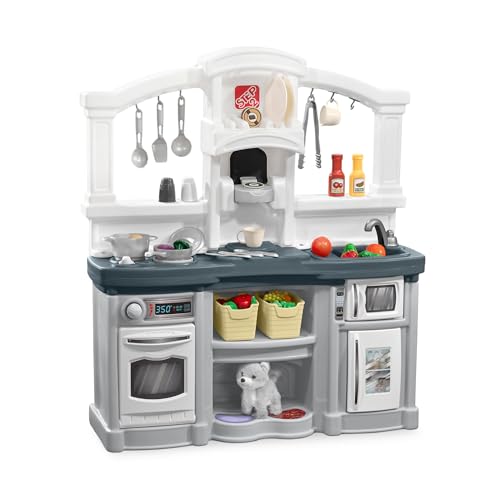
- Lights, sounds, and clicking knobs add interactive play.
- 25 accessories with built-in storage help limit clutter.
- Durable, wipe-clean plastic with a 3-year limited warranty.
Best For: Families seeking interactive features and organized storage
Best Feature-Rich Wooden Design

- Includes several pretend appliances and kitchen accessories.
- Wood construction with smooth, burr-free surfaces.
- Modern green-and-gold design with movable side handles.
Best For: Families prioritizing style and pretend appliance variety
Best Compact Toddler Pick

- Compact 11.5-inch depth fits smaller play areas.
- Lights, sounds, doors, and a pass-through window support role-play.
- Double-walled plastic and organized accessory storage improve durability and cleanup.
Best For: Toddlers and preschoolers in space-conscious homes
Best for Big-Kid Role Play
Interactive Kitchen with Laundry

- Extra-large kitchen includes a separate laundry unit.
- Running-water faucet, lights, sounds, ice maker, and phone add realism.
- Cabinets, shelves, and fabric bins provide substantial storage.
Best For: Children ages 4–7 with ample playroom space
Most Complete Accessory Set

- 130 pieces cover cooking, shopping, and serving play.
- Peel-and-cut foods support hands-on fine-motor practice.
- Includes realistic cookware, play money, and a shopping basket.
Best For: Families wanting maximum accessory variety in one pretend-play kit.
Best Adjustable Wooden Kitchen
Tiny Land Adjustable Play Kitchen

- Three height settings accommodate growing children.
- Lights, sounds, knobs, sink, oven, and microwave enrich pretend play.
- Includes cookware, play food, and chef hat and apron.
Best For: Toddlers needing a grow-with-them wooden kitchen for shared living spaces.
Best Interactive Water-Play Kitchen
Kids Play Kitchen with Steam and Sink

- Light-and-sound stovetop includes a simulated steam effect.
- Circulating-water sink supports washing and reuse play.
- Includes storage, appliances, food, and kitchen accessories.
Best For: Kids who want electronic cooking effects and hands-on sink play.
Best Compact Indoor Pick

- Light-up stove and bubbling cooking sounds
- Circulating-water sink and 52 accessories
- Compact corner-friendly design
Best For: Indoor role-play in smaller play spaces
Best Outdoor Family Pick

- Wooden outdoor design with sink and stovetop
- Adjustable removable umbrella for shade
- Chalkboard doubles as sink cover and menu board
Best For: Backyard sensory and cooperative play
Best Feature-Packed Pick
Large Kitchen with Steam Effects

- Cooking, grilling, and sink activities
- Lights, sounds, and water-activated steam
- 80+ accessories and storage bag
Best For: Siblings or friends playing together indoors
Best All-Around Value – Step2 Fun with Friends Kitchen
For families comparing play kitchens for families, the Step2 Fun with Friends model offers a practical mix of interactive play, accessory storage, and durable plastic construction. Its compact footprint and 25-piece set make it easy to add to a playroom without creating unnecessary clutter.
Best For: Toddlers and young children who enjoy interactive cooking play and families that want built-in organization.
Pros:
- Burner includes lights and sizzling sounds, while the knobs click for hands-on play.
- Includes a coffee maker, sink, faucet, opening refrigerator and oven doors, and 25 accessories.
- Built-in storage locations help children clean up independently.
- Durable, easy-to-clean plastic and a 3-year limited warranty support regular use.
Cons:
- The 2 AA batteries for the interactive burner are not included.
- Its 40.88-inch height and 24.25-pound weight may be more substantial than smaller toddler kitchens.
This is a well-rounded choice when interactive features and tidy storage matter as much as durability. The gray plastic design is also easy to wipe down and straightforward to place in a family play area.
Best Feature-Rich Wooden Design – ROBUD Wooden Play Kitchen
The ROBUD wooden play kitchen is a strong option for families looking for play kitchens for families with a more furniture-like appearance and many pretend appliances. Its green finish, gold handles, and broad feature list create an inviting play space for children ages 3 and up.
Best For: Families wanting a feature-rich wooden kitchen with a modern look and multiple pretend appliances.
Pros:
- Includes a refrigerator, ice maker, coffee machine, juicer, microwave, oven, dishwasher, utensils, and coffee cups.
- Wood construction, smooth edges, and burr-free accessories are designed for comfortable play.
- Hollow side handles make the 37.5-pound unit easier to move between rooms.
- Clear instructions are intended to make assembly manageable.
Cons:
- At 31.3 inches wide and 34.7 inches high, it may offer less standing space than extra-large models.
- Assembly is required, and the wooden construction is heavier than plastic alternatives.
Choose this ROBUD model if visual style and appliance variety are priorities. It provides a substantial collection of pretend functions while keeping the overall design refined enough for shared family spaces.
Best Compact Toddler Pick – Step2 Best Chefs Kitchen
Among play kitchens for families, the Step2 Best Chefs model is a practical toddler-focused choice for compact play areas. Its open layout supports social play, while interactive lights and sounds, storage hooks, shelves, and 25 accessories add useful play value.
Best For: Toddlers and preschoolers who need a compact, durable kitchen for social and skill-building pretend play.
Pros:
- Working oven and refrigerator doors, a pass-through window, and a light-and-sound burner encourage role-play.
- Hooks, shelves, and a recycling bin help organize the 25 included accessories.
- Double-walled plastic with molded-in colors resists chipping, fading, cracking, and peeling.
- Its 11.5-inch depth is suited to tighter play spaces.
Cons:
- The recommended age range is listed as 24 months to 5 years, so older children may outgrow it sooner.
- Interactive play requires batteries, which are not specified as included in the supplied notes.
This model makes sense when floor space is limited and durability is important. Its open design also makes it easier for more than one child to participate in pretend cooking.
Best for Big-Kid Role Play – Interactive Kitchen with Laundry
For families seeking play kitchens for families that support extended pretend play, this extra-large Kiddokidz set adds a separate laundry unit to a full kitchen layout. The tall design, running-water faucet, lights, sounds, ice maker, and play phone create a broad range of household role-play activities.
Best For: Children ages 4 to 7 who enjoy spacious, multi-activity pretend play and families with room for a larger set.
Pros:
- Combines a refrigerator, stovetop, oven, microwave, sink, and separate laundry unit.
- Includes range-hood and stovetop lights and sounds, an electric running-water faucet, ice maker, and play phone.
- Large counters, cabinets, shelves, and pull-out fabric bins provide useful storage.
- Standing height is designed for children about 40 to 50 inches tall.
Cons:
- The full footprint is 53.54 inches wide, so it requires considerable floor space.
- The running-water faucet requires six AAA batteries, which are not included.
- Assembly may require support, although customer assistance is available during the first 12 months.
This is the strongest fit for families that want a centerpiece play station rather than a compact kitchen. Its separate laundry unit and generous storage broaden the play possibilities but make room planning especially important.
Most Complete Accessory Set – 130-Piece Kitchen Playset
For families comparing play kitchens for families, this 130-piece set stands out for the sheer variety of accessories and role-play options. It combines cookware, pretend food, shopping supplies, play money, and detailed peel-and-cut activities in one kit, making it a flexible choice for children ages 3 and up.
Best For: Families seeking an accessory-heavy starter set with cooking, shopping, and food-preparation play.
Pros:
- Includes 130 pieces, including cookware, utensils, play food, a shopping basket, and pretend money.
- Peel-and-cut foods add fine-motor practice beyond basic pretend cooking.
- Features a rotating-lid pressure cooker and water-fillable kettle for more realistic role-play.
- ABS construction includes polished, burr-free edges according to the product notes.
Cons:
- The large number of pieces may require dedicated storage and cleanup.
- The set is listed in pink, which may not suit every room or preference.
- It is an accessory set rather than a full-size kitchen structure with a counter, oven, or sink.
This is a strong pick when variety matters most. Its shopping and food-preparation features broaden the play beyond cooking, while the compact accessory-focused format works well alongside an existing play kitchen.
Best Adjustable Wooden Kitchen – Tiny Land Adjustable Play Kitchen
This Tiny Land model is a practical option for families comparing play kitchens for families and looking for a more complete wooden setup. Its adjustable height, interactive lights and sounds, and included chef accessories create a full pretend-cooking station for children ages 3 to 8.
Best For: Growing toddlers who need a compact wooden kitchen that can adjust to three height settings.
Pros:
- Three height settings help the kitchen adapt as children grow.
- Light-up stove elements, an interactive range hood, and turnable knobs add sensory play.
- Includes pretend food, cookware, plates, utensils, a cup, chef hat, and apron.
- Wooden construction has smooth edges and non-toxic, BPA-free finishes according to the notes.
Cons:
- Assembly may require more time than setting up a simple accessory kit.
- The included accessory count is more limited than the 130-piece alternative.
- Its white finish may show marks more readily during messy pretend play.
Choose this kitchen when longevity and furniture-like design are priorities. The adjustable height is especially useful for siblings or a child who is likely to use the set over several years.
Best Interactive Water-Play Kitchen – Kids Play Kitchen with Steam and Sink
For families evaluating play kitchens for families, this plastic set offers several interactive features in a relatively compact footprint. Children can use the light-and-sound stovetop, simulated steam, circulating-water sink, refrigerator, oven, storage basket, and included play food for a more immersive kitchen routine.
Best For: Children who enjoy electronic effects and water-based sink play in a modern plastic kitchen.
Pros:
- The stovetop provides lights, cooking sounds, and a simulated steam effect.
- The sink uses a water-circulation system to reuse water from the faucet.
- Includes a refrigerator, oven, storage basket, blackboard, clock, play food, and utensils.
- ABS construction is described as having no sharp edges or rough materials.
Cons:
- Water features require supervision and cleanup to keep the play area dry.
- Electronic effects may need batteries, though the supplied notes do not specify battery details.
- The product dimensions and item-dimension fields are inconsistent in the listing, so buyers should verify the assembled size.
This set is a good fit when interactive effects are more important than a wood finish. Its recycled-water sink and steam-style stovetop add memorable play value, but families should plan for water management and confirm the size before ordering.
Best Compact Indoor Pick – Interactive Pink Play Kitchen
For families seeking play kitchens for families in a smaller indoor space, this 27.1-inch plastic kitchen packs in interactive features without a large footprint. The light-up stove, bubbling sounds, circulating-water sink, oven, refrigerator, storage shelves, hooks, and included storage bag create a well-equipped pretend cooking station.
Best For: Children ages 3–5, with the manufacturer also listing a recommended range through age 8, especially families wanting a space-saving indoor kitchen for role-play.
Pros:
- Light-up stove, bubbling cooking sounds, interactive oven knobs, and a pretend refrigerator add realism.
- Circulating-water sink supports pretend washing while introducing water-conservation concepts.
- Includes 52 accessories, shelves, hooks, and a storage bag for organization.
- Compact design can fit in a playroom corner.
Cons:
- The kitchen is lower than a child, so the notes recommend sitting on the floor to play.
- Made from plastic rather than wood.
This is a practical choice when interactive features and storage matter more than standing height. Its compact dimensions suit indoor play areas, while the water-circulation sink and sound effects give children several ways to extend pretend-play scenarios.
Best Outdoor Family Pick – Wooden 7-in-1 Mud Kitchen
Families comparing play kitchens for families who enjoy backyard activities may prefer this wooden mud kitchen. Designed for outdoor pretend cooking, it combines a faucet, sink, stovetop, utensil storage, wooden sand molds, an adjustable umbrella, and a chalkboard that also serves as a sink cover.
Best For: Children ages 3–8 who enjoy outdoor, sensory, and cooperative pretend play in a backyard, garden, or lawn.
Pros:
- Wood construction and included sand molds support nature-based sensory play.
- Adjustable, removable umbrella provides shade and can be taken down for indoor table use.
- Dual-purpose chalkboard works as a sink cover and a menu or drawing surface.
- Open storage keeps pots, spatulas, and pretend ingredients accessible.
Cons:
- Its 35.24-inch height and outdoor-oriented design require more space than a compact indoor set.
- The supplied notes identify the umbrella and mud kitchen as included components but do not specify a larger accessory count.
This model stands out for families who want group-friendly outdoor play rather than a conventional indoor toy kitchen. The shade feature, open storage, and chalkboard add useful flexibility, while the shared cooking format can encourage teamwork and social interaction.
Best Feature-Packed Pick – Large Kitchen with Steam Effects
For families looking for play kitchens for families that can support several children at once, this large plastic set offers cooking, grilling, and sink play in one station. It includes light and sound effects, a water-circulation faucet, a steam-producing burner, more than 80 accessories, and a storage bag.
Best For: Children ages 3–5, with the manufacturer recommending the set for ages 3–6, particularly siblings or friends who want multiple pretend-play activities.
Pros:
- Three-in-one layout combines cooking, grilling, and washing activities.
- One burner produces gentle steam when water is added, alongside lights and cooking sounds.
- Includes more than 80 accessories, including cookware, play food, dishes, a clock, and a small blackboard.
- Larger dimensions are intended to allow multiple children to play together.
Cons:
- Requires five AA batteries for sound and light features, and batteries are not included.
- The larger footprint may be less suitable for very small play areas.
- Made from plastic rather than wood.
This is the strongest fit for households prioritizing variety and shared play. Its accessory count and three-part design give children plenty to do, while the steam effect adds realism; just plan for battery purchases and adequate floor space.
How We Picked the Best Play Kitchens for Families
We compared these Play Kitchens for Families by looking at construction, play value, included accessories, size, interactive features, storage potential, and suitability for shared use. We also considered the differences between plastic and wood, indoor and outdoor designs, and fixed-height versus adjustable models.
Because family needs vary, there is no single best kitchen for every home. A smaller set may work better in an apartment, while a larger model can support siblings or playdates. Lights, sounds, steam effects, and extensive food sets can increase engagement, but they may also require batteries, additional cleanup, or closer supervision.
Quick Comparison
- Best for interactive play: Models with lights, sounds, steam effects, or realistic controls.
- Best for durability: Sturdy wooden kitchens with reinforced construction and stable bases.
- Best for growing children: Adjustable-height designs that can be modified as kids get taller.
- Best for accessories: Sets with cookware, pretend food, utensils, baskets, and storage areas.
- Best for outdoor use: Mud kitchens made for imaginative cooking with natural materials.
Key Buying Factors for Play Kitchens for Families
Size and Shared Play
Measure the floor area and account for doors, walkways, and nearby furniture. If two children will play together, look for enough counter space, multiple activity zones, or access from more than one side. A compact kitchen may be easier to store but can feel crowded during sibling play.
Materials and Stability
Plastic sets are often lighter and easier to clean, while wooden kitchens typically provide a more substantial appearance and feel. Check the product dimensions, base stability, rounded edges, and recommended age range. Secure tall or freestanding units according to the manufacturer’s instructions.
Features and Maintenance
Interactive elements can make pretend cooking more engaging, but confirm whether batteries are needed and whether sound levels can be managed. For younger children, avoid small accessories that may create a choking hazard. Choose wipe-clean surfaces and practical storage if the kitchen will be used daily.
Indoor or Outdoor Placement
Indoor kitchens are generally easier to protect and organize. Outdoor mud kitchens offer sensory play but need weather-appropriate placement, drainage, and regular cleaning. Do not assume an outdoor product is fully weatherproof unless the manufacturer says so.
Who Should Buy Which Play Kitchens for Families?
Choose a plastic interactive set if your child enjoys buttons, lights, sounds, and easy-clean surfaces. Choose a wooden kitchen if you prioritize a furniture-like look, stable construction, and long-term use. Choose an adjustable model for children at different heights or families hoping to extend the usable lifespan. Choose an accessory-heavy set if your child enjoys sorting, serving, and role-play beyond the kitchen itself. Choose an outdoor mud kitchen if you have suitable backyard space and want open-ended sensory play.