The best sensory tables for home use give toddlers and young children a dedicated space for sand, water, rice, crafts, and imaginative play. The right design can make setup easier while keeping materials contained and accessible.
These 10 options range from compact indoor tables to larger wooden activity stations with stools, storage bins, lids, and adjustable or double-sided surfaces. Use the guide below to match the table with your space, cleanup preferences, and the kind of play your child enjoys most.
Best 10 Sensory Tables for Home Use Picks for 2026
Best All-Ages Growth Pick
Skip Hop Discoverosity Sensory Table

- Three modes from floor play to elevated play
- 24-piece set with 13 nature-inspired tools
- Includes an 8-page guide and two sensory bins
Best For: Growing toddlers and preschoolers who need varied sensory activities
Best Compact Beach-Style Option

- Separate wells for sand and water
- Includes six play accessories
- Removable legs and a dual-sided lid
Best For: Compact sand-and-water play for children ages 2 and up
Best Multiuse Furniture Design

- Doubles as a study, toy, or dining table
- Includes three storage organizers
- Wood frame with rounded corners and covers
Best For: Indoor playrooms needing sensory storage and everyday table use
Best Outdoor-Ready Learning Table
PHOKID Wooden Sensory Play Table

- Four modes including sand, water, art, and dino digging
- Includes two basins, acrylic board, and water-track toys
- UV/rain cover supports outdoor use
Best For: Ages 3+ and families wanting versatile indoor-outdoor play
Best Foldable Pick

- Foldable design with storage bins
- Reversible whiteboard and chalkboard lids
- Wipe-clean surface with rounded edges
Best For: Space-conscious homes wanting versatile sensory and creative play
Best Complete Set
VEVOR Sensory Table with Stools

- Includes two stools and activity supplies
- Reversible chalkboard and whiteboard tabletop
- Bin supports sand, water, or toy play
Best For: Shared play and early-learning activities for ages 3–6
Best Multi-Bin Design
Frogprin Sensory Activity Table

- Three bins for storage and sensory play
- Reversible writable covers
- Solid pine frame with rounded corners
Best For: Toddlers and preschoolers needing organized sensory activities
Best Adjustable Pick

- Three height settings for ages 3–6
- Two removable bins for sand, water, or toys
- Sturdy frame with rounded corners and non-slip feet
Best For: Growing preschoolers and shared sensory play
Best Storage Design
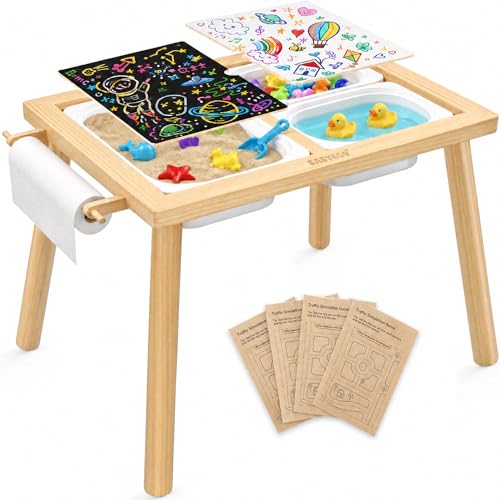
- Three foldable bins organize play materials
- Paper roller supports drawing and accessory storage
- Pine wood build with rounded corners and non-slip feet
Best For: Craft-focused playrooms and compact learning spaces
Best Simple Pick
VEVOR Sensory Table and Chairs Set

- Includes table and two stools
- Two bins plus a paper roll holder
- Wood and MDF design for play and drawing
Best For: Seated sensory play and creative activities
Best All-Ages Growth Pick – Skip Hop Discoverosity Sensory Table
If you want sensory tables for home use that can adapt as your child grows, the Skip Hop Discoverosity is a versatile choice. It supports floor play, table play, and elevated play, with tools and activity ideas for sand, water, dry pasta, clay, and other fillers.
Best For: Families seeking a multi-stage indoor sensory table for toddlers and preschoolers ages 18 months and up.
Pros:
- Offers three play modes for different developmental stages.
- Includes 13 sensory tools, two bins, two lids, a play track, and an activity guide.
- Supports more than 30 activities involving scooping, pouring, sorting, sculpting, and pretend play.
- Designed with sensory development, motor skills, coordination, and cause-and-effect learning in mind.
Cons:
- Fillers such as sand, water, pasta, and clay are not included.
- The wood tabletop add-on is sold separately.
- Although intended for indoor use, the listing contains conflicting battery information despite describing manual operation.
With its extensive accessories and adaptable height, this is one of the more feature-rich sensory tables for home use. It is especially appealing when you want one setup to remain useful through several stages of early childhood.
Best Compact Beach-Style Option – Kidoozie Sand 'n Splash Table
For simple sensory tables for home use, the Kidoozie Sand ‘n Splash Activity Table brings separate sand and water play into a compact setup. Its removable legs and dual-sided lid also make cleanup, storage, and transport straightforward.
Best For: Children ages 2 and up who enjoy straightforward sand-and-water play indoors or outdoors.
Pros:
- Includes separate sand and water wells for two types of sensory play.
- Comes with a rake, shovel, bucket, sand mold, boat, and crab stamp.
- Legs remove so the table and accessories can be stored or transported together.
- The lid covers the compartments after play to help contain the pieces.
Cons:
- Its compact 17 x 12.5 x 11-inch size offers less play space than larger tables.
- The product listing recommends outdoor use, so indoor placement may require extra cleanup planning.
- It is primarily designed for sand and water rather than a broad range of sensory fillers.
This table is a practical pick when you want beach-inspired play without a large footprint. The included accessories and storage-focused design make it convenient for occasional backyard, playroom, or travel use.
Best Multiuse Furniture Design – WINGYZ Toddler Sensory Table
The WINGYZ sensory table stands out among sensory tables for home use because it can also function as a study, toy, or dining table. Its wood frame includes storage, removable boards, and rounded corners for a setup that fits multiple activities in a playroom.
Best For: Toddlers, preschoolers, and kindergarteners who need an indoor activity table with storage and everyday utility.
Pros:
- Can be used for sensory play, studying, toys, and dining.
- Includes three organizers, two table boards, and a paper-tube holder component.
- Rounded corners and anti-slip foot stickers support a more child-friendly setup.
- The two covers have holes intended to make removal easier.
Cons:
- Assembly is required, and a screwdriver is recommended.
- The table is relatively large at about 30 x 21 x 17.5 inches, so it needs dedicated floor space.
- The listing notes that tabletop covers may be damaged during shipping.
If you need sensory play furniture that can stay useful beyond one activity, the WINGYZ offers strong versatility. Its storage and paper-holder features are helpful for homes where the same table must support play, art, learning, and meals.
Best Outdoor-Ready Learning Table – PHOKID Wooden Sensory Play Table
For families comparing sensory tables for home use with outdoor flexibility, the PHOKID Wooden Sensory Play Activity Table combines sand, water, art, and dinosaur-themed digging. Its two basins, acrylic board, water-track toys, and included cover support several play formats for children ages 3 and up.
Best For: Children ages 3 to 8 who enjoy collaborative sensory play, simple STEM exploration, and outdoor activities.
Pros:
- Offers four play modes: water, sand, art, and dinosaur digging.
- Includes two collapsible basins, a double-sided dinosaur puzzle, acrylic board, and water-track toys.
- The acrylic panel can divide or connect play areas and also works as a washable drawing surface.
- Sealed pine wood, rounded edges, leg caps, and a UV/rain cover support indoor or outdoor use.
Cons:
- Sand and water are not listed among the included components.
- Its approximately 25.8 x 17.9 x 18-inch footprint may be limiting for larger groups.
- The product is recommended for ages 3 and up, making it less suitable for younger toddlers.
This PHOKID table is a strong option when you want sensory play to include art, themed discovery, and water-track experimentation. The flexible acrylic divider and weather cover also make it well suited to shared play and changing locations.
Best Foldable Pick – 7 Days of Play Sensory Table
For families comparing sensory tables for home use, this 7 Days of Play model stands out for its foldable design and flexible play surface. Flip the lids for a whiteboard and chalkboard, or remove them to access the spacious sensory bins for scooping, pouring, and texture-based play.
Best For: Homes that need a versatile sensory table that can be folded away after playtime.
Pros:
- Foldable legs and storage bins help save space.
- Reversible lids provide whiteboard and chalkboard surfaces.
- Smooth, wipe-clean surface and rounded edges support easier cleanup and safer play.
- Supports sensory play, crafts, homework, dining, and writing activities.
Cons:
- Assembly requires a screwdriver and Allen key.
- Seating capacity is listed for one person.
- Designed for indoor use.
Choose this table if storage convenience is a priority and you want one compact station for messy sensory activities, drawing, and everyday kids’ tasks.
Best Complete Set – VEVOR Sensory Table with Stools
Among sensory tables for home use, the VEVOR set offers a ready-to-use activity area with two stools and supplies for drawing and early learning. Its reversible tabletop supports chalkboard and whiteboard activities, while the bin accommodates sand, water, or toys.
Best For: Families seeking a two-child table with included seating and creative-learning accessories.
Pros:
- Includes two stools, magnetic letters, markers, chalk, and an eraser.
- Reversible tabletop supports drawing, writing, reading, and dining.
- Bin works for sand, water, or toy storage.
- Rounded corners and non-slip feet add child-friendly practicality.
Cons:
- Recommended for children ages 3–6.
- Assembly is required.
- The engineered-wood tabletop may appeal less to shoppers seeking an all-solid-wood construction.
This is a strong option when you want more than a bare table: the included stools and activity materials make it especially convenient for shared play, drawing, and preschool-style learning.
Best Multi-Bin Design – Frogprin Sensory Activity Table
For shoppers looking at sensory tables for home use, the Frogprin table combines a large bin with two smaller storage bins in a compact square design. Its removable black-and-white writable lids support drawing, while the table can also be used for crafts, reading, homework, dining, and sand or water play.
Best For: Toddlers and preschoolers who benefit from separate bins for sensory materials and toys.
Pros:
- Three bins provide flexible storage and sensory-play options.
- Reversible writable covers support drawing and easy erasing.
- Solid pine construction is designed for durability.
- Rounded corners, smooth edges, and anti-slip foot stickers support safer play.
Cons:
- Seating capacity is listed for one person.
- Assembly requires an Allen key and screwdriver.
- The supplied notes list different age references, so shoppers should confirm suitability for their child.
The Frogprin is a practical choice when separate compartments matter most. Its combination of storage, writable covers, and indoor or outdoor suitability makes it adaptable for everyday family play.
Best Adjustable Pick – VEVOR 2-Station Sensory Table
For families comparing sensory tables for home use, this VEVOR model stands out for its two separate bins, adjustable height, and indoor/outdoor flexibility. The removable bins make it practical for sand, water, toys, and cleanup.
Best For: Families with children ages 3 to 6 who want a height-adjustable table for solo or shared sensory play.
Pros:
- Three height settings accommodate growing children.
- Two detachable bins support separate activities or group play.
- Carbon steel frame and PP bins support up to 66 pounds.
- Rounded corners, non-slip feet, and easy-lift bins simplify everyday use.
Cons:
- At nearly 43 inches wide, it requires more floor space than compact tables.
- Covered storage is recommended when used outdoors.
This is a strong practical choice when adjustability and two-station play matter most. Its lightweight construction and removable bins also make moving and rinsing straightforward.
Best Storage Design – Easyego Wooden Sensory Table
Among sensory tables for home use, the Easyego wooden model is a versatile option for play, crafts, and organization. Its three foldable bins and built-in paper roller give children space for sensory materials while keeping supplies close at hand.
Best For: Homes or learning spaces that need a compact wooden table for sensory play, crafts, and storage.
Pros:
- Three foldable bins hold sand, water, toys, or craft supplies.
- Built-in paper roller supports drawing and can hold towels or storage bags.
- Pine wood construction has a water-based varnish finish.
- Rounded corners and non-slip leg pads help with stability and floor protection.
Cons:
- Paper for the roller is not included.
- The listed dimensions provide less play area than larger two-station tables.
- Assembly requires a screwdriver and wrench.
The Easyego is especially useful when creative activities and storage are as important as sand or water play. Its natural wood design also fits more easily into many home learning areas.
Best Simple Pick – VEVOR Sensory Table and Chairs Set
For shoppers seeking sensory tables for home use with seating included, this VEVOR table-and-chairs set combines a wooden activity surface with two stools. Two storage bins and a paper roll holder support sand and water play, drawing, and everyday creative activities.
Best For: Children who need a dedicated seated space for sensory play, drawing, and hands-on activities.
Pros:
- Includes two stools for a ready-to-use activity area.
- Two storage bins help keep play materials nearby.
- Paper roll holder adds drawing and art functionality.
- Wood and MDF construction suits indoor or outdoor use.
Cons:
- The supplied notes do not specify adjustable height.
- Storage capacity is limited to two bins.
- Product care calls for wiping with a damp cloth rather than rinsing.
This set is a convenient choice for families who want seating included rather than purchasing stools separately. It works well as a multifunctional table for play, drawing, and learning.
How We Picked the Best Sensory Tables for Home Use
We focused on features that matter in everyday family use: sturdy construction, age-appropriate height, removable or covered bins, storage capacity, cleanup convenience, and versatility. Tables that support more than one activity—such as sand and water play, crafts, drawing, or building—received particular consideration for homes where space is limited.
We also compared practical details such as foldable legs, included stools, writable lids, non-slip feet, double-sided boards, and indoor/outdoor suitability. Always check the manufacturer’s recommended age range, dimensions, materials, and supervision guidance before buying.
Quick Comparison
| Best for | Features to prioritize | Good choice when |
|---|---|---|
| Small indoor spaces | Compact footprint, foldable legs, covered bins | You need easy storage between activities |
| Sand and water play | Deep removable bins, lids, drainage-friendly design | Your child enjoys messy sensory materials |
| Shared play | Two stations, stools, or broad tabletop | More than one child may play together |
| Crafts and learning | Writable surfaces, activity boards, paper-roll holder | You want creative play beyond sand and water |
| Outdoor use | Weather-resistant materials, stable legs, non-slip feet | The table will live on a patio or play area |
Key Buying Factors for Sensory Tables for Home Use
Size, Height, and Placement
Measure the available floor area before ordering, including room for children to stand or sit around the table. A toddler-height model is convenient for younger children, while adjustable or larger tables may remain useful as they grow. Consider whether the table must pass through doors or be stored in a closet.
Bins, Lids, and Cleanup
Removable bins make it easier to change materials and wash the play surface. Lids help contain sand, protect unfinished activities, and reduce dust between sessions. For frequent water play, look for sturdy containers and a setup that can be emptied without carrying a heavy, full bin across the room.
Stability and Materials
Choose a table with a wide, stable base, secure hardware, and non-slip feet where appropriate. Wooden models can offer a substantial feel, while plastic designs may be lighter and simpler to clean. Inspect surfaces for smooth edges and follow the care instructions to prevent swelling, staining, or premature wear.
Versatility and Included Accessories
Activity boards, stools, storage bins, paper-roll holders, and tool sets can add value, but accessories should not outweigh basic build quality. Think about the materials your child already enjoys and whether the table supports open-ended play rather than only one themed activity.
Who Should Buy Which Sensory Tables for Home Use?
Choose a compact foldable table if storage and quick cleanup are your main concerns. Families wanting a complete activity station should consider a model with stools, multiple bins, or an integrated board. For siblings or playdates, a two-station design provides better access and reduces crowding. If your child mainly enjoys tactile play, prioritize deep removable bins and durable surfaces; if crafts and early learning are equally important, look for writable tops, activity guides, or paper-storage features.
Whichever table you choose, use age-appropriate materials, supervise water and small loose parts, and store sensory fillers securely when play is finished.