The best sensory wall panels for adults do more than add visual interest: they provide purposeful tactile activities for memory care, rehabilitation, classrooms, and multi-sensory spaces.
This roundup compares 10 selected panels and panel sets, from large dementia activity boards to modular textured tiles, reversible sequins, and heat-sensitive designs. Use the guide below to match the format, features, and upkeep requirements to your space.
Best 10 Sensory Wall Panels for Adults Picks for 2026
Best for Dementia Care
XXL Handcrafted Dementia Board

- More than 35 interactive sensory tools
- Large plywood panel for shared care use
- Wall kit, stand, and personalization included
Best For: Adult dementia and Alzheimer’s therapy environments
Best for Visual Tactile Stimulation

- Three oversized sequin fabric panels
- Flip designs for tactile creativity
- Usable on walls, floors, and tables
Best For: Flexible sensory rooms and creative activity areas
Best Modular Set
Choose-Three Wooden Activity Boards
- Select three activity-board designs
- Mixed textures and interactive elements
- Compact 18-inch square wooden format
Best For: Customizable multi-sensory rooms and therapy spaces
Best Customizable Texture Set

- 13 textured mats in a modular layout
- Interchangeable sequins and Velcro backing
- Machine-washable mats for easier upkeep
Best For: Customizable indoor sensory and education spaces
Best Overall
Six-Panel Interactive Sensory Set
- Six varied tactile and activity boards
- Approximately 18-by-18-inch panels
- Useful for indoor rooms and therapy spaces
Best For: Flexible indoor sensory areas needing varied activities
Most Customizable
DIY Sequin and Texture Wall Kit

- Nine pads and seven flip-sequin mats
- Frames and mounting hardware included
- Can be arranged on walls or used on floors
Best For: Personalized sensory layouts in homes, offices, or break areas
Best for Texture Variety

- Four framed panels with assorted fabrics
- Includes mesh, velvet, and pom-pom textures
- Panels can be arranged in different layouts
Best For: Indoor tactile corners focused on fabric exploration
Best with Extra Features

- 12 tactile squares with varied textures
- Works on walls or floors
- Includes nano tape for setup
Best For: Flexible sensory corners and mixed-texture exploration
Best for Visual Feedback
Heat-Sensitive Interactive Panels

- Two differently sized interactive panels
- Touch produces temperature-based color changes
- Wooden frames suit therapy and classroom spaces
Best For: Multisensory rooms and touch-and-color activities
Best for Large Wall Coverage

- Large 41.1-by-19.06-inch wall display
- Eight tactile fabric sections
- Peel-and-stick setup for smooth walls
Best For: Decorative sensory corners and broad wall coverage
Best for Dementia Care – XXL Handcrafted Dementia Board
If you need sensory wall panels for adults in a memory-care or rehabilitation setting, this extra-large handcrafted dementia board emphasizes hands-on activity. It includes more than 35 interactive tools intended to encourage focus, coordination, and motor-skill practice.
Best For: Seniors with dementia or Alzheimer’s in care homes, clinics, and occupational-therapy environments.
Pros:
- Extra-large 23.6-by-39.4-inch format with more than 35 interactive tools.
- Strong plywood construction designed for daily occupational use.
- Includes wall-mounting hardware, a wooden stand, and personalization with a name or institution.
Cons:
- At 17.6 pounds, it is substantially heavier than many compact activity panels.
- Its dementia-care focus may be more specialized than needed for general adult sensory use.
This is the most purpose-built option here for adult memory-care settings. Its size and broad mix of activities suit shared use, provided you have adequate wall or floor space.
Best for Visual Tactile Stimulation – Reversible Sequin Wall Fabric
For flexible sensory wall panels for adults, this three-piece sequin fabric set offers a simple way to add visual and tactile interaction to a room. Users can flip the sequins to create images, letters, and patterns, and the panels can also be used on tables or floors.
Best For: Sensory rooms, creative spaces, classrooms, and photo-backdrop applications needing lightweight, repositionable texture.
Pros:
- Three large fabric panels, each measuring approximately 51.18 by 19.7 inches.
- Double-sided sequins support tactile play, visual tracking, and pattern-making.
- Can be placed on walls, floors, tables, or desks and comes in three color combinations.
Cons:
- The product is marketed primarily for children, so it may feel less substantial for intensive adult therapy use.
- Fabric panels provide sequin-based interaction rather than a broad range of sensory tools.
This set works best when portability and visual engagement matter more than a rigid, permanently mounted board. It can also double as colorful room decor or a creative backdrop.
Best Modular Set – Choose-Three Wooden Activity Boards
These wooden activity boards are a versatile choice if you want sensory wall panels for adults alongside a broader multi-sensory setup. The pack lets you choose three boards featuring options such as gears, an abacus, sequins, fidget spinners, turf, a chalkboard, or a Buddha Board.
Best For: Multi-sensory rooms, therapy spaces, classrooms, waiting rooms, and bedrooms that benefit from varied activity types.
Pros:
- Pack of three boards, each approximately 18 by 18 by 1.5 inches.
- Choice of activity styles supports different textures, movements, and visual experiences.
- Wood-and-mixed-material construction requires no batteries and is intended for indoor use.
Cons:
- The specific activities depend on which three boards you choose.
- The listed recommended age begins at three years, so adult suitability depends on the room’s goals and users.
This is a strong pick when variety and customization are priorities. Selecting complementary boards can create a more balanced station than relying on one repeated activity.
Best Customizable Texture Set – Honeycomb Sensory Wall Tiles
Although designed for children, this honeycomb set can be considered among sensory wall panels for adults when a configurable tactile display is useful. It combines textured mats, interchangeable sequin pieces, and a blank board that can hold photos or notes.
Best For: Indoor sensory rooms and educational spaces that need modular textures, visual customization, and easy-clean components.
Pros:
- Includes 13 sensory mats with textures ranging from soft and rough to bumpy.
- Honeycomb layout supports personalization, while Velcro attachments help prevent slipping.
- Several mats are machine washable, supporting routine hygiene.
Cons:
- It is specifically aimed at children ages 3–12 and special-education classrooms.
- Individual mats are relatively small at approximately 7.4 by 9 inches.
- The pine construction and colorful design may not suit every adult-care environment.
This set is most appropriate when adjustability and cleanable tactile surfaces are more important than an adult-oriented appearance. For adult use, consider the setting and whether its child-focused design is acceptable.
Best Overall – Six-Panel Interactive Sensory Set
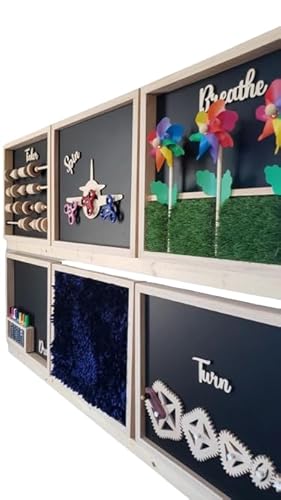
For shoppers comparing sensory wall panels for adults, this six-piece set offers a broad mix of tactile, movement, visual, and hands-on activities. Each approximately 18-by-18-inch panel is designed for indoor use in sensory rooms, classrooms, clinics, waiting rooms, or bedrooms.
Best For: Flexible indoor sensory spaces that need several different activity types in one set.
Pros:
- Includes six distinct interactive panels for varied sensory exploration.
- Activity options may include spin, breathe, scratch, touch, create, and count designs.
- Suitable for classrooms, clinics, waiting rooms, bedrooms, and sensory rooms.
- Large approximately 18-by-18-inch panel format provides a substantial interactive surface.
Cons:
- Designed for indoor use only.
- The listed recommended age is 36 months to 3 years, so adult users should consider fit for their specific needs.
- Manual operation means activities do not provide powered or automated interaction.
Its strongest advantage is variety: buyers can create a more engaging sensory area without sourcing individual boards separately. Review the included activity styles and dimensions to confirm they suit the intended adult environment.
Most Customizable – DIY Sequin and Texture Wall Kit
This LILXIU kit stands out among sensory wall panels for adults for its configurable layout and combination of textured pads and reversible sequin mats. The included frames, mounting hardware, and loose-use option make it adaptable for walls or floors in homes, offices, classrooms, sensory rooms, and break areas.
Best For: Buyers who want to arrange tactile panels in a personalized wall or floor configuration.
Pros:
- Includes nine sensory pads, seven flip-sequin mats, nine wooden frames, and expansion screws.
- Panels can be freely combined to create different configurations.
- Flip sequins provide a touch-responsive, two-color visual and tactile activity.
- Frames can be mounted, while pads may also be placed directly on the floor.
Cons:
- At approximately 8.2 by 0.5 by 9.4 inches, the individual pieces are smaller than some large-format wall boards.
- Installation requires using the included screwdriver and screws.
- The notes emphasize early-learning benefits, so adult users should assess whether the textures and sequin interaction match their preferences.
The modular design is the key selling point, especially where a fixed panel arrangement would be limiting. Its textured surfaces and flip-sequin interaction may also suit a designated relaxation or break area.
Best for Texture Variety – Four-Piece Tactile Panel Set
For those seeking sensory wall panels for adults with a straightforward tactile focus, this four-piece set combines assorted fabrics and trims in wooden frames. The panels are intended for indoor exploration and can be mixed and matched to create a tactile corner or interactive wall.
Best For: Quiet rooms or shared spaces where varied fabric textures and a simple wall display are the priority.
Pros:
- Four unique panels offer contrasting textures, including mesh, dotted velvet, and pom-pom trims.
- Solid pine frames are described as sturdy, smooth, and splinter-free.
- Panels can be mixed, matched, and arranged in different layouts.
- Supports tactile exploration, focus, and calming hands-on engagement.
Cons:
- Indoor use only.
- It provides four panels, fewer than the six-panel and 16-piece options listed here.
- The manufacturer recommended age is 0 to 3 years, so adult buyers should verify that the styling and texture set meet their intended use.
This is a relatively simple choice for anyone who values fabric variety over mechanical or counting activities. Its wooden frames and flexible arrangement make it suitable for building a dedicated tactile area, provided the smaller set size is sufficient.
Best with Extra Features – 12-Piece Sensory Square Set
For shoppers comparing sensory wall panels for adults or shared spaces, this 12-piece set stands out for its range of tactile surfaces. The squares include soft, squishy, rough, and bumpy textures, and they can be arranged on a wall or floor using the included nano tape.
Best For: Flexible sensory corners, classrooms, and home setups that benefit from multiple removable texture tiles.
Pros:
- Includes 12 panels with varied tactile textures.
- Can be used on walls or floors.
- Simple setup with supplied nano tape.
- Designed for sensory needs, autism, and attention challenges.
Cons:
- The product is marketed primarily for children ages 3 and up.
- The supplied notes do not specify individual panel dimensions or long-term adhesive performance.
This is a practical pick when variety and rearrangement matter more than a single large display. Adults seeking sensory wall panels may appreciate the range of textures, but the child-focused design and age guidance should be considered.
Best for Visual Feedback – Heat-Sensitive Interactive Panels
These heat-sensitive panels offer a more interactive approach to sensory wall panels for adults and children. Their thermochromic surfaces respond to touch within a stated 27–33°C range, creating gradual color changes that add visual feedback to tactile exploration.
Best For: Therapy rooms, multisensory spaces, and educational settings where touch and color response are useful.
Pros:
- Two-panel set provides different sizes for varied interaction.
- Color changes are triggered by temperature-sensitive touch.
- Wooden frames support frequent use and add a finished appearance.
- Designed for sensory development, motor skills, and therapeutic play.
Cons:
- Color changes depend on hand temperature being within the stated range.
- The supplied age guidance is children ages 3–12, rather than adults specifically.
- The notes do not provide detailed mounting instructions.
Compared with texture-only options, this set adds an immediate visual response that can encourage attention and experimentation. It is especially suited to structured therapy or learning environments, provided the temperature-dependent response matches the intended use.
Best for Large Wall Coverage – Crocodile Felt Activity Board
This crocodile-shaped felt board provides broad wall coverage with eight tactile fabric sections. For anyone evaluating sensory wall panels for adults or communal areas, its large 41.1-by-19.06-inch format can create a prominent sensory feature while offering smooth, bumpy, silky, and fuzzy surfaces.
Best For: Sensory corners, waiting rooms, nurseries, and classrooms needing a large, soft, decorative wall display.
Pros:
- Large wall-mounted design offers substantial coverage.
- Includes eight contrasting tactile fabric sections.
- Peel-and-stick adhesive dots simplify installation on smooth walls.
- Washable, lightweight felt and fabric construction.
Cons:
- The playful crocodile design is clearly aimed at children.
- Adhesive mounting is specified for smooth walls, which may limit placement options.
- The supplied notes do not identify the adhesive dots as reusable.
This board is a strong choice when visual appeal and wall coverage are priorities. Its child-oriented crocodile shape may be less suitable for adult-only interiors, but the varied fabrics and large format can work well in shared sensory environments.
How We Picked These Sensory Wall Panels for Adults
We selected products across the main formats used in therapy and activity spaces: large all-in-one boards, framed tactile panels, modular tile sets, sequin surfaces, and interactive color-changing panels. We considered the type and variety of sensory input, the usefulness of each activity for adults, mounting flexibility, material construction, cleaning needs, and whether the design suits memory-care or clinical environments.
Product descriptions vary in their stated dimensions and intended age range, so verify measurements, included hardware, and material details before ordering. For adult-focused use, prioritize purposeful interaction and robust construction over bright colors or novelty alone.
Quick Comparison
| Panel Type | Best For | Main Advantage | Check Before Buying |
|---|---|---|---|
| Large activity board | Memory care and rehabilitation | Many activities in one installation | Wall space and secure anchoring |
| Framed tactile set | Therapy rooms and classrooms | Organized texture variety | Frame strength and cleaning |
| Modular tiles or mats | Flexible sensory walls | Layout can be expanded or rearranged | Attachment method and edge security |
| Sequin or heat-sensitive panel | Visual and tactile engagement | Immediate interactive feedback | Fabric wear, heat response, and supervision |
Key Buying Factors for Sensory Wall Panels for Adults
Purpose and Sensory Input
Decide whether the panel is intended for fine-motor practice, calming repetitive motion, visual stimulation, reminiscence support, or general engagement. Knobs, switches, latches, spinners, textured surfaces, and fabric panels provide different forms of interaction. A mixed-activity board may suit a rehabilitation clinic, while simpler textures can work better in a calming room.
Durability and Safety
Look for solid wood or reinforced frames, securely attached components, rounded edges, and hardware that can withstand repeated use. Avoid loose parts or delicate embellishments in settings where users may pull, twist, or mouth objects. Confirm the mounting system can support the finished weight and use appropriate anchors for the wall type.
Cleaning and Accessibility
High-contact panels should have surfaces that can be wiped without damaging the finish. Textured fabric, felt, and sequins may collect dust and require gentler cleaning. Check that activities are positioned at an accessible height and can be reached from a seated position when needed.
Size, Layout, and Installation
Measure the available wall area, including clearance for wheelchairs and caregivers. Large boards simplify installation but offer less layout flexibility. Individual tiles allow custom arrangements, although they may require more precise mounting and alignment.
Who Should Buy Which Sensory Wall Panels for Adults?
Memory-care facilities and rehabilitation clinics: Choose a substantial activity board with multiple purposeful components and a sturdy frame. Therapy and multi-sensory rooms: A framed set with contrasting textures offers variety without overwhelming the wall. Classrooms and flexible spaces: Modular squares or tiles are easier to rearrange as needs change. Users seeking visual-tactile stimulation: Reversible sequin or heat-sensitive panels provide immediate feedback, but they should be selected for durability and supervised where appropriate.
Before purchasing, confirm the exact panel count, dimensions, mounting hardware, cleaning instructions, and return policy. The right sensory wall panel should fit the users, the room, and the level of daily wear—not simply offer the largest number of features.